
Clio to iManage Data Migration
Moving from Clio to iManage? Mine automates the mapping between Clio's practice management data model and iManage's document management architecture — preserving matter records, client contacts, document metadata, and billing history.
Working with enterprise teams on active migration programs
2–4 weeks
to production-ready mappings
40–50%
cost reduction vs. manual migration
90%+
average mapping confidence
Most enterprise migrations start 6+ months behind schedule. Yours doesn't have to.
This guide is for VPs of IT, data architects, and migration leads at companies moving data from Clio to iManage — whether you're scoping, planning, or mid-program.
Clio stores practice management data in matters, contacts, calendar entries, tasks, time entries, and documents using a cloud-native API. iManage stores documents in workspaces organized by client/matter with metadata profiles, security policies, and records management rules. Mine maps Clio's broad practice management data to iManage's document-centric workspace model — focusing on the matter-to-workspace and document metadata translation.
Based on enterprise migration programs led by Mine's founding team
Last updated March 2026
How Mine automates your Clio to iManage migration
Mine maps Clio matters to iManage workspaces with client/matter hierarchy, workspace template selection based on practice area, and metadata profile assignment — generating the complete workspace creation specification.
Documents are profiled for metadata enrichment — Mine analyzes filenames, file types, and matter context to propose iManage document type classifications (brief, contract, correspondence, memo) that Clio doesn't track.
Clio's matter permission model is translated to iManage's security framework — workspace security inheritance, team access groups, and ethical wall requirements are identified before any documents migrate.
Mine generates the complete migration manifest — workspace creation order, document filing locations, metadata assignments, and security configurations — ready for the iManage implementation team.
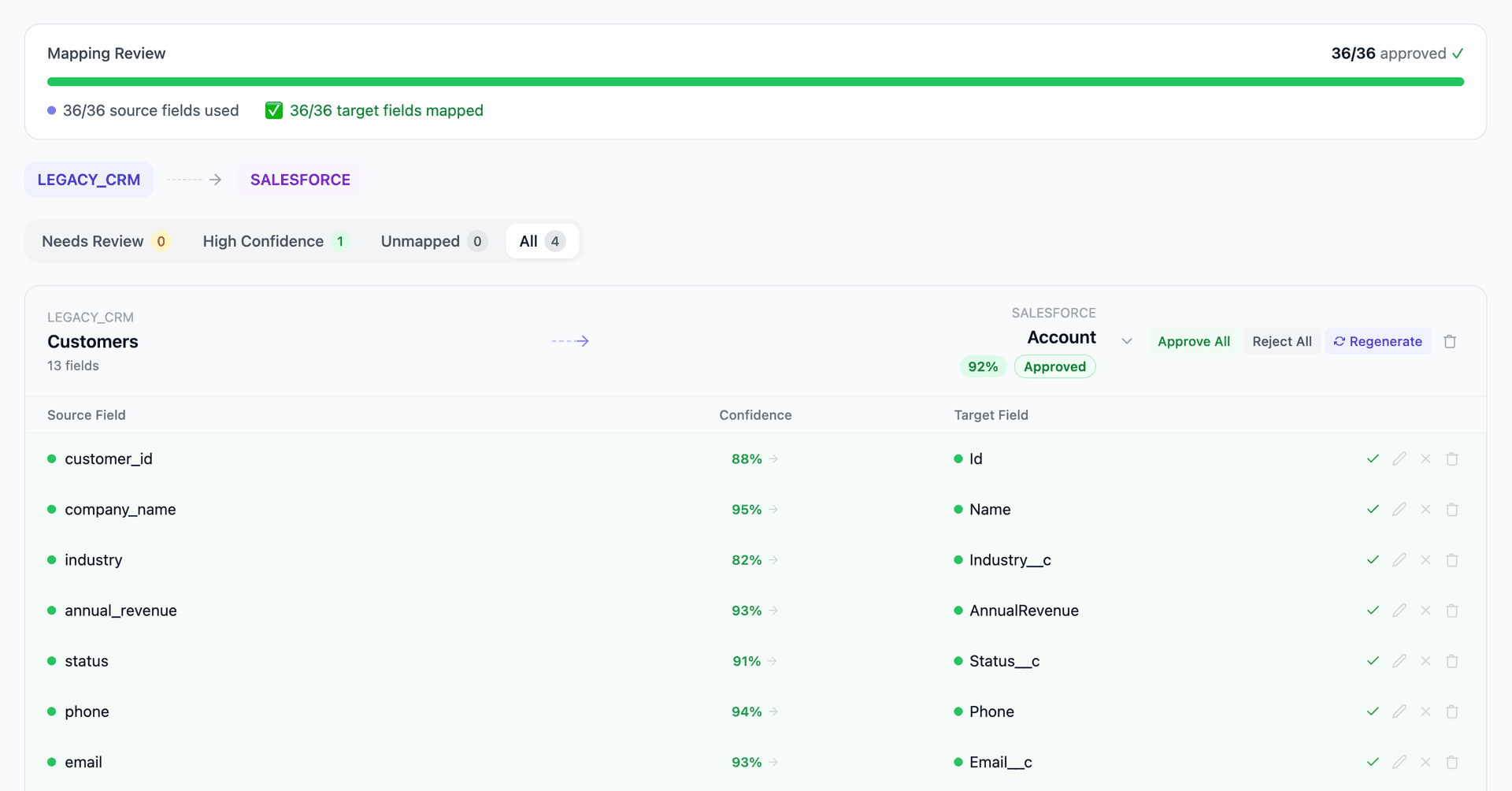
Get your Clio to iManage mapping analysis — see results in under an hour
Migration timeline: manual vs. Mine
Traditional approach
Timeline
2–6 months
Estimated cost
$50K–250K
Team size
2–4 legal IT consultants
Typically requires
×Manual field mapping in spreadsheets
×Custom ABAP/SQL extraction scripts
×3–5 mock migration cycles
×Dedicated source system consultants
×Manual reconciliation testing
With Mine
Enterprise benchmarksTimeline
2–4 weeks
Team size
1–2 internal resources
Estimated cost
40–50% less
Included
✓Schema profiling & analysis
✓AI-generated field mappings
✓Transformation SQL
✓Validation & readiness reports
✓Production-ready load files
Common challenges migrating from Clio to iManage
Matter to workspace creation
Clio matters contain case details, responsible attorneys, practice areas, and status. iManage workspaces organize around client/matter with workspace templates, metadata profiles, and security. Each Clio matter must generate an iManage workspace with the correct template, metadata inheritance, and security assignment. Mine maps Clio matter fields to iManage workspace metadata and generates the workspace creation specifications.
Explore related migrations →Document metadata enrichment
Clio documents have basic metadata — filename, upload date, matter association. iManage expects richer metadata — document type (brief, contract, correspondence, memo), author, practice area, security class, custom fields. The migration must enrich Clio's basic metadata into iManage's structured profile. Mine analyzes filenames and file types to propose document type classifications.
Explore related migrations →Version control and document history
Clio stores documents as uploaded files without version control. iManage uses a check-in/check-out version control model where each edit creates a new version. Documents migrating from Clio enter iManage as version 1 with no prior history. Mine ensures documents are correctly filed with proper metadata so version control starts cleanly.
Explore related migrations →Security and ethical walls
Clio uses matter-level permissions. iManage supports granular security — workspace security, document security, ethical walls between matters, and conflict of interest restrictions. The security model must be designed before documents migrate. Mine maps Clio's permission model to iManage's security framework and flags matters that require ethical wall configuration.
Explore related migrations →Clio to iManage field mapping — what data moves
9 data objects typically migrated
| Source Object | → | Target Object |
|---|---|---|
| Matter | → | Workspace |
| Contact (client) | → | Client metadata |
| Document | → | Document (with metadata profile) |
| Folder structure | → | Workspace tabs / Subfolders |
| Matter custom fields | → | Workspace custom metadata |
| Responsible attorney | → | Workspace owner / Author |
| Practice area | → | Workspace template / Profile |
| Time entry (reference) | → | Not migrated (stays in Clio) |
| Email attachment | → | Email filing (iManage) |
Typical enterprise migrations include 500K–10M+ records across these objects. Mine handles profiling and mapping at any scale.
The cost of manual Clio to iManage migration
These migrations are typically managed by legal IT consultants over 2–6 months. The workspace creation, metadata enrichment, and security policy configuration are the most demanding parts.
Frequently asked questions
Related migration paths
In one enterprise migration, a single field mapping error in customer master data caused $100K in billing discrepancies that went undetected for 6 months.
Mine catches these issues before they reach production.
Built by a team that led SAP, Oracle, and Salesforce data migration programs for Fortune 500 companies at a Big 4 consulting firm. Currently in design partnership with enterprise clients running active migration programs.
Ready to migrate from Clio to iManage?
Tell us about your migration and we'll show you how Mine can help.
No commitment required. We'll review your migration scope and share a preliminary assessment within 48 hours.
You'll receive a preliminary mapping analysis showing how your source objects map to your target schema, with confidence scores and flagged risk areas.