
HubSpot to Salesforce Data Migration
Migrate your contacts, companies, deals, and engagement history from HubSpot to Salesforce without losing pipeline context. Mine automates the property-to-field mapping that makes CRM-to-CRM migrations so tedious.
Working with enterprise teams on active migration programs
2–4 weeks
to production-ready mappings
40–50%
cost reduction vs. manual migration
90%+
average mapping confidence
Most enterprise migrations start 6+ months behind schedule. Yours doesn't have to.
This guide is for VPs of IT, data architects, and migration leads at companies moving data from HubSpot to Salesforce — whether you're scoping, planning, or mid-program.
HubSpot uses a flexible property-based system where contacts and companies can have hundreds of custom properties without formal type constraints, while Salesforce enforces strict field types with validation rules, picklist values, and field-level security. Mine analyzes each property's actual data content to determine the optimal Salesforce field type — not just its declared type.
Based on enterprise migration programs led by Mine's founding team
Last updated March 2026
How Mine automates your HubSpot to Salesforce migration
Mine profiles every HubSpot property's actual data content — not just its declared type — to determine the optimal Salesforce field type, length, and validation rules.
Deal pipeline and stage mappings are proposed automatically with probability scores aligned to Salesforce's forecasting model. Multi-pipeline configurations are mapped to Salesforce record types.
Engagement history is mapped to the correct Salesforce activity objects (Tasks, Events, EmailMessages) with all timestamps, associations, and metadata preserved.
Mine generates a complete Contact-to-Lead-or-Contact routing strategy based on your data — flagging records that should enter as Leads vs. those that should be created as converted Contacts with Account relationships.
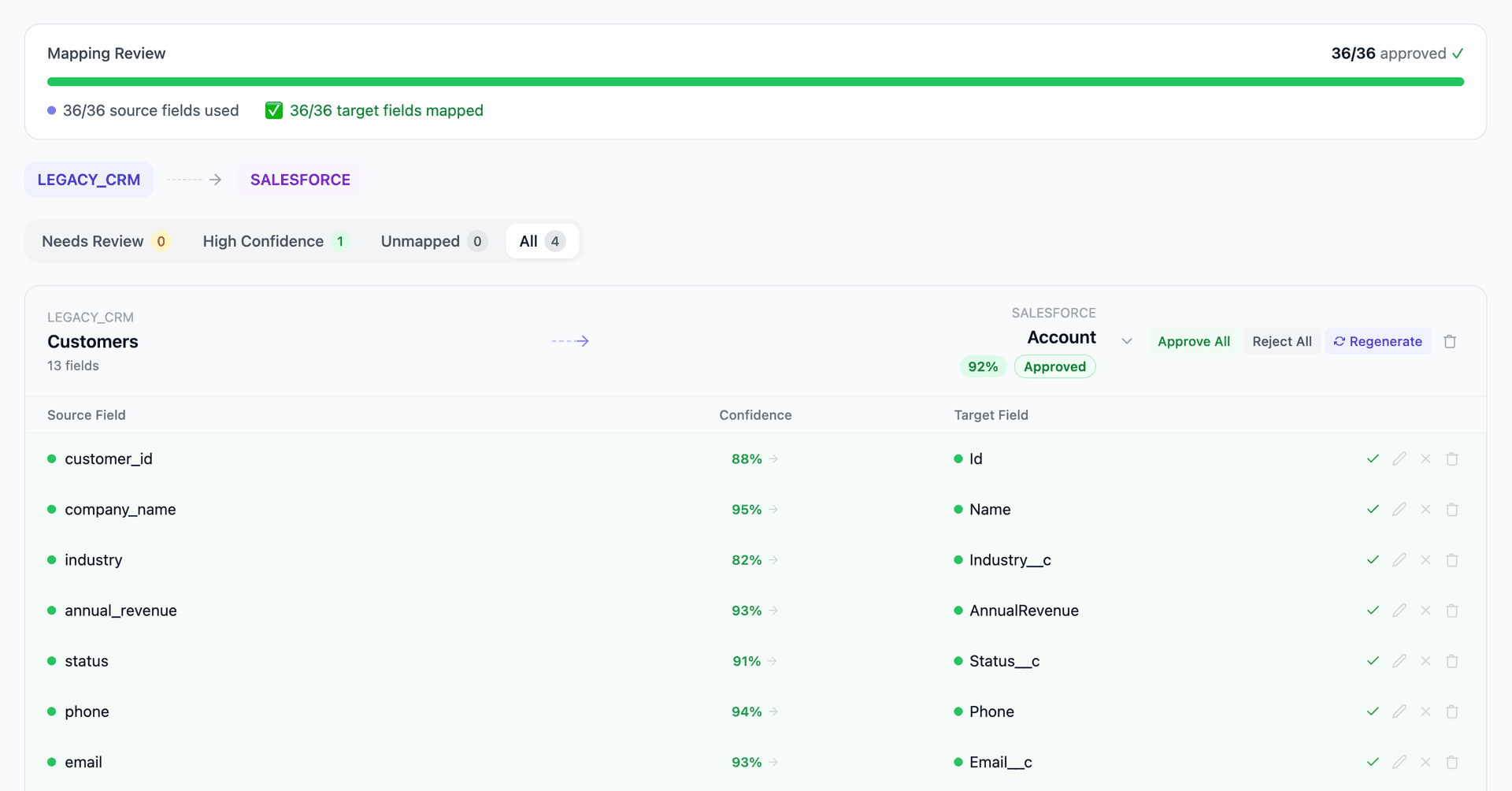
Get your HubSpot to Salesforce mapping analysis — see results in under an hour
Migration timeline: manual vs. Mine
Traditional approach
Timeline
2–6 months
Estimated cost
$100K–500K
Team size
2–4 consultants
Typically requires
×Manual field mapping in spreadsheets
×Custom ABAP/SQL extraction scripts
×3–5 mock migration cycles
×Dedicated source system consultants
×Manual reconciliation testing
With Mine
Enterprise benchmarksTimeline
2–4 weeks
Team size
1 internal resource
Estimated cost
40–50% less
Included
✓Schema profiling & analysis
✓AI-generated field mappings
✓Transformation SQL
✓Validation & readiness reports
✓Production-ready load files
Common challenges migrating from HubSpot to Salesforce
Property-to-field type mapping
HubSpot properties are loosely typed — a 'single-line text' property might contain phone numbers, URLs, or freeform text. Salesforce requires explicit field types (Phone, URL, Text). Each property must be analyzed for its actual content, not just its declared type, to determine the correct Salesforce field.
Explore related migrations →Deal stage and pipeline mapping
HubSpot supports multiple pipelines with custom deal stages. Salesforce uses Sales Processes, Opportunity stages, and record types. The mapping isn't one-to-one — HubSpot stages may need to be consolidated, split, or reorganized to fit Salesforce's stage probability model.
Explore related migrations →Engagement history and activity timeline
HubSpot tracks emails, meetings, calls, and notes as engagements tied to contacts and deals. Salesforce stores these as Tasks, Events, and EmailMessages with different relationship models. Preserving the full activity timeline requires careful object mapping and timestamp handling.
Explore related migrations →Association labels and custom relationships
HubSpot's association labels allow flexible many-to-many relationships between objects. Salesforce uses lookup and master-detail relationships with more rigid cardinality rules. Complex association patterns may require junction objects in Salesforce.
Explore related migrations →HubSpot to Salesforce field mapping — what data moves
11 data objects typically migrated
| Source Object | → | Target Object |
|---|---|---|
| Contacts | → | Lead / Contact |
| Companies | → | Account |
| Deals | → | Opportunity |
| Tickets | → | Case |
| Products | → | Product2 / OpportunityLineItem |
| Engagements (Emails) | → | EmailMessage / Task |
| Engagements (Meetings) | → | Event |
| Engagements (Calls) | → | Task |
| Notes | → | ContentNote / Note |
| Custom Objects | → | Custom Objects |
| Lists / Workflows | → | Reports / Flows |
Typical enterprise migrations include 500K–10M+ records across these objects. Mine handles profiling and mapping at any scale.
The cost of manual HubSpot to Salesforce migration
Most companies use the native HubSpot-Salesforce sync connector for ongoing integration, but it doesn't support bulk historical migration. Teams typically fall back to CSV exports and Salesforce Data Loader, spending weeks mapping properties manually and fixing data quality issues one field at a time.
Frequently asked questions
Related migration paths
In one enterprise migration, a single field mapping error in customer master data caused $100K in billing discrepancies that went undetected for 6 months.
Mine catches these issues before they reach production.
Built by a team that led SAP, Oracle, and Salesforce data migration programs for Fortune 500 companies at a Big 4 consulting firm. Currently in design partnership with enterprise clients running active migration programs.
Ready to migrate from HubSpot to Salesforce?
Tell us about your migration and we'll show you how Mine can help.
No commitment required. We'll review your migration scope and share a preliminary assessment within 48 hours.
You'll receive a preliminary mapping analysis showing how your source objects map to your target schema, with confidence scores and flagged risk areas.