
Jira to ServiceNow Data Migration
Consolidating from Jira to ServiceNow? Mine automates the mapping between Jira's issue-based model and ServiceNow's ITIL-aligned service management tables — preserving issue history, custom fields, and workflow states.
Working with enterprise teams on active migration programs
2–4 weeks
to production-ready mappings
40–50%
cost reduction vs. manual migration
90%+
average mapping confidence
Most enterprise migrations start 6+ months behind schedule. Yours doesn't have to.
This guide is for VPs of IT, data architects, and migration leads at companies moving data from Jira to ServiceNow — whether you're scoping, planning, or mid-program.
Jira stores work items as Issues with configurable issue types, workflows, and custom fields in a project-based hierarchy, while ServiceNow uses ITIL-aligned tables — Incidents, Requests, Problems, Changes — with assignment groups and SLA management. Mine translates Jira's flexible issue tracking model to ServiceNow's structured ITSM framework automatically.
Based on enterprise migration programs led by Mine's founding team
Last updated March 2026
How Mine automates your Jira to ServiceNow migration
Mine classifies Jira issues into ServiceNow tables based on issue type, project, and custom field analysis — Incidents to incident, Service Requests to sc_request, Changes to change_request — with routing rules you approve.
Custom Jira workflows are mapped to ServiceNow state flows with state consolidation rules for non-standard workflow states that don't have ServiceNow equivalents.
Custom fields are profiled and mapped to ServiceNow dictionary entries — with recommendations for which become table fields, service catalog variables, or ServiceNow custom fields.
Mine preserves the full issue history — comments, status changes, assignee changes, and worklogs — translated to ServiceNow's activity log format.
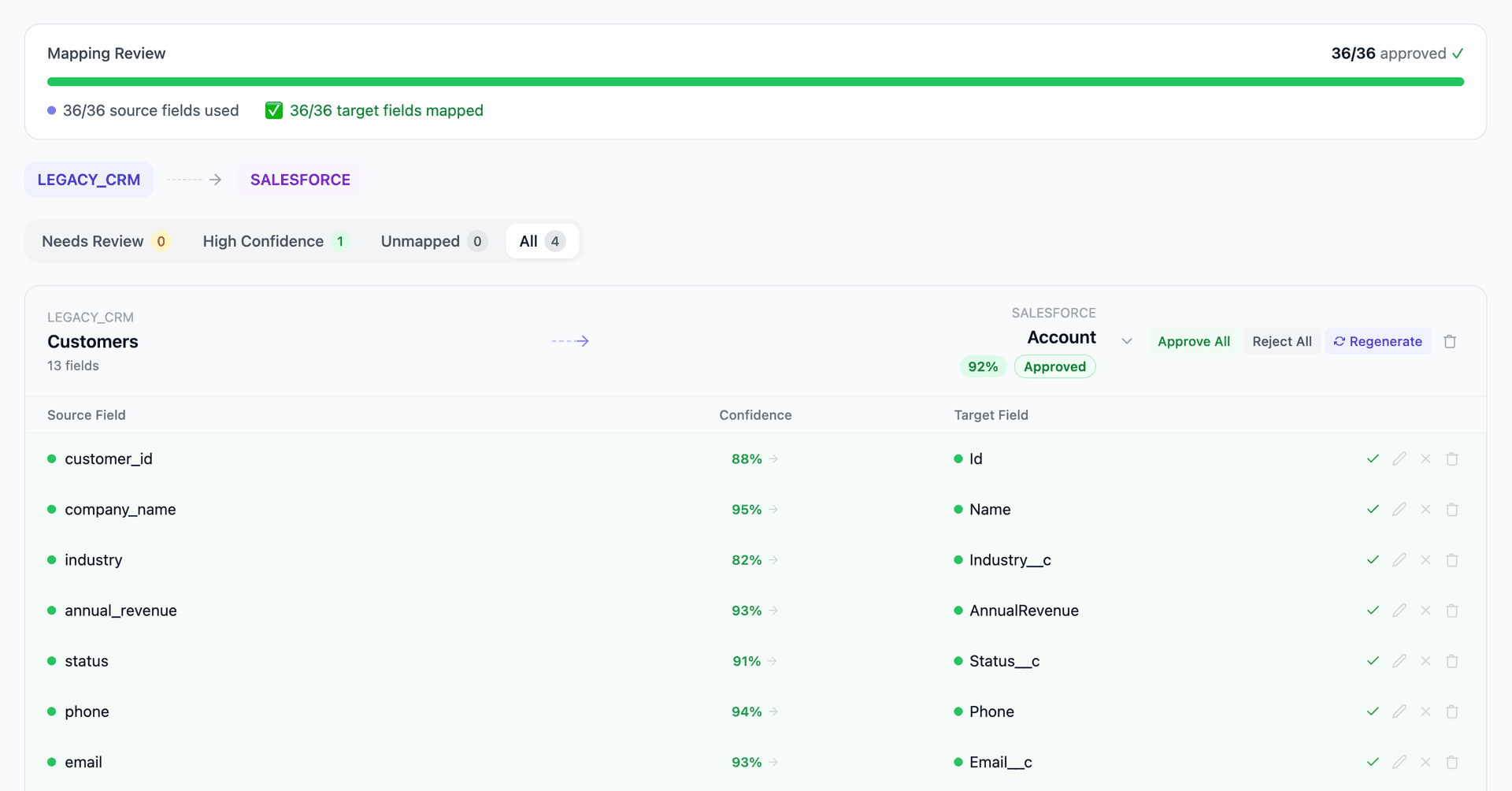
Get your Jira to ServiceNow mapping analysis — see results in under an hour
Migration timeline: manual vs. Mine
Traditional approach
Timeline
2–4 months
Estimated cost
$100K–400K
Team size
2–4 consultants
Typically requires
×Manual field mapping in spreadsheets
×Custom ABAP/SQL extraction scripts
×3–5 mock migration cycles
×Dedicated source system consultants
×Manual reconciliation testing
With Mine
Enterprise benchmarksTimeline
2–4 weeks
Team size
1 internal resource
Estimated cost
40–50% less
Included
✓Schema profiling & analysis
✓AI-generated field mappings
✓Transformation SQL
✓Validation & readiness reports
✓Production-ready load files
Common challenges migrating from Jira to ServiceNow
Issue type to ServiceNow table routing
Jira issue types (Bug, Story, Task, Epic, Service Request, Incident) must route to the correct ServiceNow table. Standard Jira Service Management types map naturally (Incident → incident, Service Request → sc_request), but custom issue types and subtasks require analysis. The routing decision must be made per project and issue type combination.
Explore related migrations →Workflow state to ServiceNow state mapping
Jira workflows are highly customizable — each project and issue type can have different workflow states and transitions. ServiceNow uses standardized state flows per table (New → In Progress → Resolved → Closed for incidents). Mapping custom Jira workflow states to ServiceNow's fixed state model requires consolidation of non-standard states.
Explore related migrations →Custom fields and screen configurations
Jira allows unlimited custom fields with screen-level control over which fields appear for which issue types. ServiceNow uses dictionary entries and form layouts. Each Jira custom field needs a ServiceNow equivalent — either a standard field, a variable in the service catalog, or a custom field on the appropriate table.
Explore related migrations →Agile and sprint data
Jira's agile boards, sprints, story points, and velocity data have no ServiceNow ITSM equivalent. If the team uses agile methodology, this data may be archived, migrated to ServiceNow's Agile Development module (if licensed), or kept in a separate system. Mine flags agile-specific data and recommends the handling approach.
Explore related migrations →Jira to ServiceNow field mapping — what data moves
10 data objects typically migrated
| Source Object | → | Target Object |
|---|---|---|
| Issue (Incident type) | → | Incident |
| Issue (Service Request) | → | Service Request (sc_request) |
| Issue (Change) | → | Change Request |
| Issue (Bug/Story) | → | Problem / Enhancement |
| Comment | → | Work Note / Comment |
| Attachment | → | Attachment (sys_attachment) |
| Component | → | Service / CI Reference |
| Custom Fields | → | Table fields / Variables |
| Project | → | Assignment Group / Category |
| Worklog | → | Time Entry |
Typical enterprise migrations include 500K–10M+ records across these objects. Mine handles profiling and mapping at any scale.
The cost of manual Jira to ServiceNow migration
Companies typically manage this migration during ServiceNow implementation. The issue classification (which Jira issues become which ServiceNow records) and custom field translation are the most labor-intensive parts.
Frequently asked questions
In one enterprise migration, a single field mapping error in customer master data caused $100K in billing discrepancies that went undetected for 6 months.
Mine catches these issues before they reach production.
Built by a team that led SAP, Oracle, and Salesforce data migration programs for Fortune 500 companies at a Big 4 consulting firm. Currently in design partnership with enterprise clients running active migration programs.
Ready to migrate from Jira to ServiceNow?
Tell us about your migration and we'll show you how Mine can help.
No commitment required. We'll review your migration scope and share a preliminary assessment within 48 hours.
You'll receive a preliminary mapping analysis showing how your source objects map to your target schema, with confidence scores and flagged risk areas.