Legacy HR System to Workday Data Migration
Replacing a homegrown HRIS with Workday? Mine profiles any HR database and automates the mapping to Workday's worker-centric model — even when the source has no documentation and decades of accumulated data.
Working with enterprise teams on active migration programs
3–6 weeks
to production-ready mappings
40–50%
cost reduction vs. manual migration
90%+
average mapping confidence
Most enterprise migrations start 6+ months behind schedule. Yours doesn't have to.
This guide is for VPs of IT, data architects, and migration leads at companies moving data from Legacy Database to Workday — whether you're scoping, planning, or mid-program.
Legacy HR systems — custom SQL databases, Access-based HRIS, FileMaker payroll, or homegrown web apps — have unique schemas with undocumented relationships, inconsistent data types, and years of accumulated quality issues. Workday requires clean, structured worker data loaded through EIB or custom integrations. Mine bridges this gap by inferring your HR schema and mapping it to Workday's worker model automatically.
Based on enterprise migration programs led by Mine's founding team
Last updated March 2026
How Mine automates your Legacy Database to Workday migration
Mine profiles any HR database and infers the employee data model — discovering which tables represent employees, jobs, departments, pay, and benefits even without documentation.
Historical data is extracted where available — Mine detects history tables, 'previous' fields, and audit logs to reconstruct as much event history as possible for Workday's effective-dated model.
HR data quality is scanned comprehensively — SSN format validation, date format consistency, gender/ethnicity standardization, and active/terminated status verification — with remediation recommendations.
Mine generates Workday EIB-ready files organized by business object — workers, positions, compensation, benefits — with the correct effective dates and loading sequence.
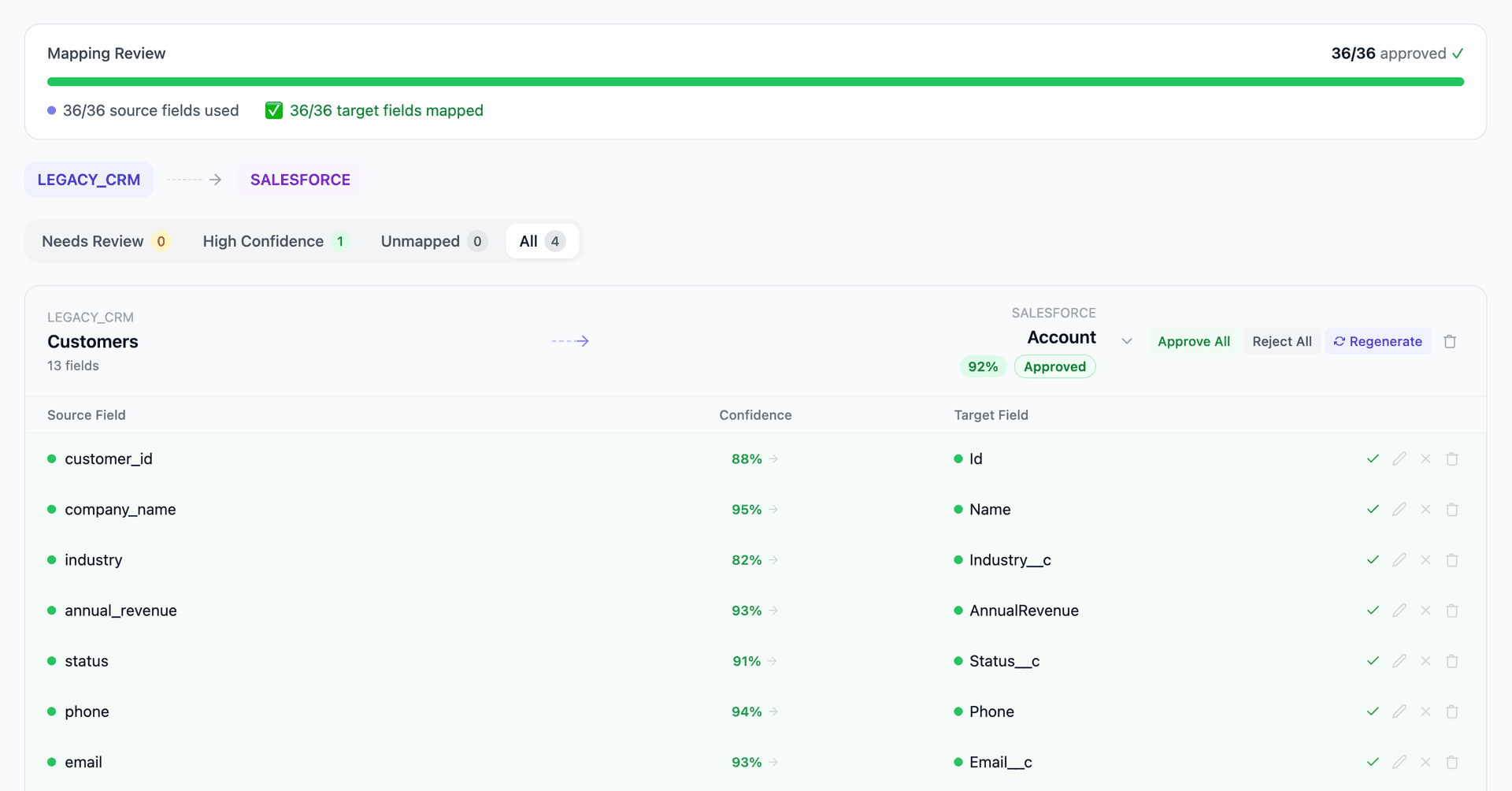
Get your Legacy Database to Workday mapping analysis — see results in under an hour
Migration timeline: manual vs. Mine
Traditional approach
Timeline
4–8 months
Estimated cost
$300K–1M
Team size
3–6 consultants
Typically requires
×Manual field mapping in spreadsheets
×Custom ABAP/SQL extraction scripts
×3–5 mock migration cycles
×Dedicated source system consultants
×Manual reconciliation testing
With Mine
Enterprise benchmarksTimeline
3–6 weeks
Team size
1–2 internal resources
Estimated cost
40–50% less
Included
✓Schema profiling & analysis
✓AI-generated field mappings
✓Transformation SQL
✓Validation & readiness reports
✓Production-ready load files
Common challenges migrating from Legacy Database to Workday
Undocumented HR schema discovery
Legacy HR databases rarely have documentation. Table names may be cryptic (tbl_emp, hr_master, pay_rec). Relationships between employee data, job data, and pay data may not use foreign keys. Mine profiles the database and infers the HR data model from data patterns.
Explore related migrations →No effective dating or event history
Many legacy HR systems only store current state — the current job, current salary, current address. Workday requires effective-dated events for job changes, pay changes, and transfers. If the legacy system has no history, Mine generates a single 'initial load' event for each worker. If partial history exists (e.g., a 'previous_title' column), Mine extracts it.
Explore related migrations →HR data quality and compliance
Legacy HR databases accumulate quality issues — incomplete Social Security numbers, inconsistent date formats, gender fields with mixed values (M/F/Male/Female/1/0), and terminated employees mixed with active. Workday has strict data quality requirements for compliance. Every field needs validation before loading.
Explore related migrations →Pay and benefits data fragmentation
Legacy systems may store pay data in the HR database, a separate payroll system, and spreadsheets for benefits. Consolidating these fragmented data sources into Workday's unified compensation and benefits model requires cross-system reconciliation.
Explore related migrations →Legacy Database to Workday field mapping — what data moves
9 data objects typically migrated
| Source Object | → | Target Object |
|---|---|---|
| Employee / Staff table | → | Worker |
| Job / Position table | → | Position / Job Profile |
| Department / Org table | → | Supervisory Organization |
| Pay / Salary table | → | Compensation Plan |
| Benefits / Insurance table | → | Benefit Election |
| Dependents / Family table | → | Dependent |
| Address / Contact table | → | Worker Address / Contact |
| Leave / PTO table | → | Time Off Balance |
| Emergency Contact table | → | Emergency Contact |
Typical enterprise migrations include 500K–10M+ records across these objects. Mine handles profiling and mapping at any scale.
The cost of manual Legacy Database to Workday migration
Companies typically hire an HR consultant and a database developer to reverse-engineer the schema. This manual approach takes 4–8 months for HR databases with 20–100 tables.
Frequently asked questions
Related migration paths
In one enterprise migration, a single field mapping error in customer master data caused $100K in billing discrepancies that went undetected for 6 months.
Mine catches these issues before they reach production.
Built by a team that led SAP, Oracle, and Salesforce data migration programs for Fortune 500 companies at a Big 4 consulting firm. Currently in design partnership with enterprise clients running active migration programs.
Ready to migrate from Legacy Database to Workday?
Tell us about your migration and we'll show you how Mine can help.
No commitment required. We'll review your migration scope and share a preliminary assessment within 48 hours.
You'll receive a preliminary mapping analysis showing how your source objects map to your target schema, with confidence scores and flagged risk areas.