
SAP ECC HR to Workday Data Migration
Moving from SAP HCM to Workday? Mine automates the mapping between SAP's infotype-based HR data model and Workday's worker-centric architecture — preserving employee history, org structures, compensation, and benefits.
Working with enterprise teams on active migration programs
6–10 weeks
to production-ready mappings
40–50%
cost reduction vs. manual migration
90%+
average mapping confidence
Most enterprise migrations start 6+ months behind schedule. Yours doesn't have to.
This guide is for VPs of IT, data architects, and migration leads at companies moving data from SAP ECC HR to Workday — whether you're scoping, planning, or mid-program.
SAP ECC HR stores employee data across infotypes — PA0001 (organizational assignment), PA0002 (personal data), PA0006 (addresses), PA0008 (pay) — each representing a time-dependent data slice. Workday uses a fundamentally different worker-centric model where all data relates to a worker record through effective-dated business processes. Mine translates SAP's infotype architecture to Workday's worker model automatically.
Based on enterprise migration programs led by Mine's founding team
Last updated March 2026
How Mine automates your SAP ECC HR to Workday migration
Mine profiles all SAP infotypes and maps each to the corresponding Workday worker object — PA0001 to organizational assignment, PA0002 to personal data, PA0008 to compensation plan — with field-level mapping including custom infotype extensions.
SAP org structures (org units, positions, jobs) are mapped to Workday's supervisory organization hierarchy with reporting line preservation and position management translation.
Compensation data across PA0008 (basic pay), PA0014 (deductions), and custom wage types is mapped to Workday compensation plans, earning codes, and deduction codes with payroll continuity validation.
Mine generates effective-dated transaction history from SAP's time-dependent infotype records — reconstructing the Workday event timeline that business processes require.
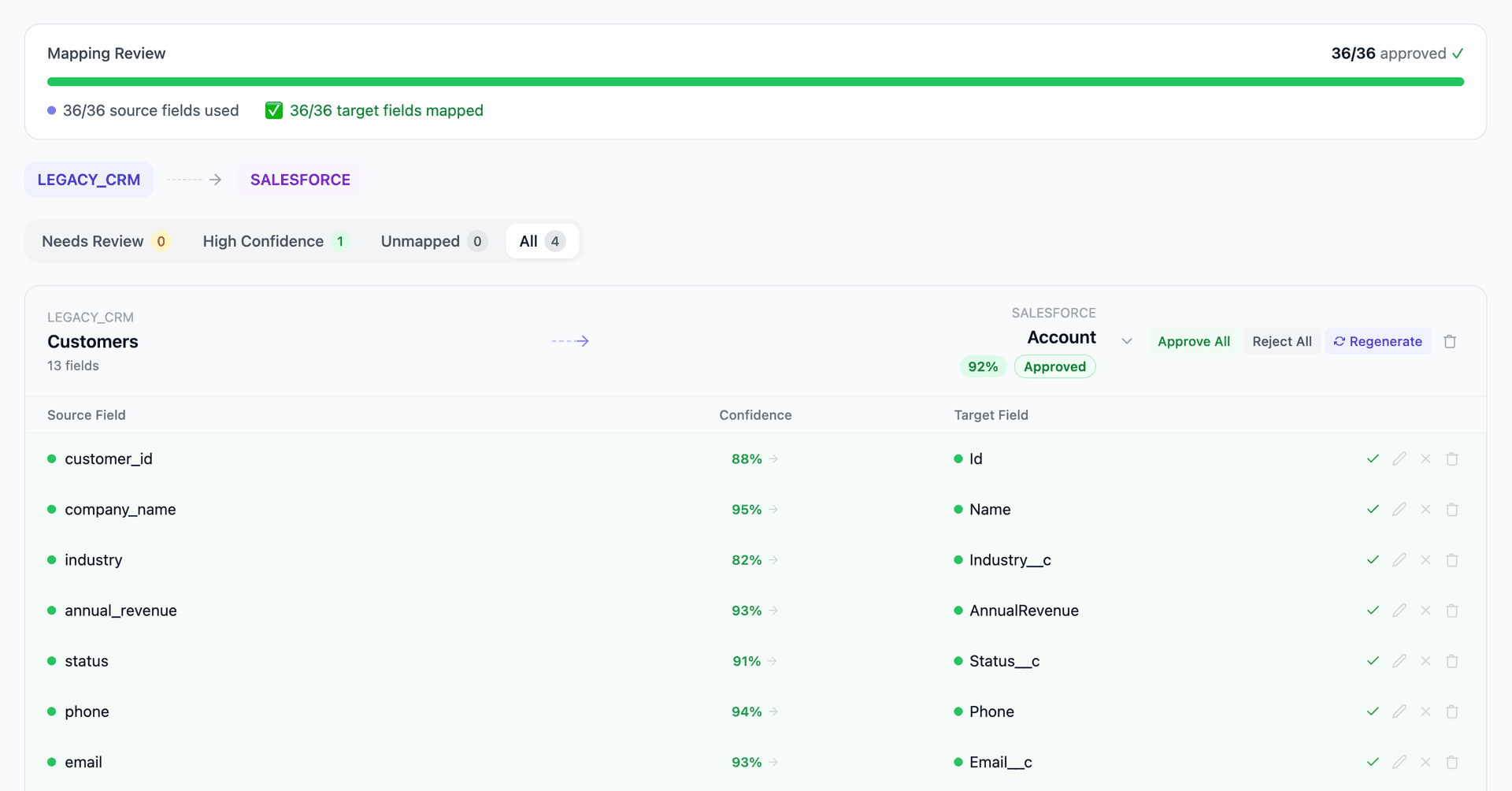
Get your SAP ECC HR to Workday mapping analysis — see results in under an hour
Migration timeline: manual vs. Mine
Traditional approach
Timeline
12–18 months
Estimated cost
$2M–8M
Team size
8–15 consultants
Typically requires
×Manual field mapping in spreadsheets
×Custom ABAP/SQL extraction scripts
×3–5 mock migration cycles
×Dedicated source system consultants
×Manual reconciliation testing
With Mine
Enterprise benchmarksTimeline
6–10 weeks
Team size
2–4 internal resources
Estimated cost
40–50% less
Included
✓Schema profiling & analysis
✓AI-generated field mappings
✓Transformation SQL
✓Validation & readiness reports
✓Production-ready load files
Common challenges migrating from SAP ECC HR to Workday
Infotype architecture to Workday worker model
SAP stores HR data across 100+ infotypes, each with its own table structure and time-dependency rules. Workday organizes all data around the worker record through business processes and effective-dated events. Translating infotype snapshots into Workday's event-based history requires mapping each infotype to the correct Workday business process and reconstructing the event timeline.
Explore related migrations →Organizational structure translation
SAP uses organizational units (org units), positions, and jobs in an Enterprise Structure. Workday uses supervisory organizations, positions, and job profiles in a different hierarchy model. The org structure mapping affects reporting lines, security, and business process routing — it must be architected before employee data can migrate.
Explore related migrations →Compensation and payroll continuity
SAP pay scale structures (PA0008), recurring deductions (PA0014), and wage types must map to Workday compensation plans, earning codes, and deduction codes. Payroll continuity across the cutover — ensuring employees are paid correctly in the first Workday payroll run — is the highest-risk element of the migration.
Explore related migrations →Historical data and time-dependent records
SAP infotypes store full history with begin/end dates for every change. Workday uses effective-dated transactions. Deciding how much history to migrate (full career history vs. current snapshot plus recent changes) significantly impacts timeline and complexity. Each historical infotype record must be converted to a Workday effective-dated transaction.
Explore related migrations →SAP ECC HR to Workday field mapping — what data moves
11 data objects typically migrated
| Source Object | → | Target Object |
|---|---|---|
| PA0001 (Org Assignment) | → | Worker / Position |
| PA0002 (Personal Data) | → | Worker Personal Info |
| PA0006 (Addresses) | → | Worker Address |
| PA0008 (Basic Pay) | → | Compensation Plan |
| PA0014 (Recurring Ded.) | → | Deduction |
| PA0021 (Family Members) | → | Dependent |
| PA0105 (Communication) | → | Worker Contact Info |
| PA0041 (Date Specs) | → | Worker History Events |
| HRP1000/1001 (Org Units) | → | Supervisory Organization |
| T527X (Positions) | → | Position |
| PA0167 (Benefits) | → | Benefit Election |
Typical enterprise migrations include 500K–10M+ records across these objects. Mine handles profiling and mapping at any scale.
The cost of manual SAP ECC HR to Workday migration
These migrations are typically managed by HR consulting firms (Deloitte, Mercer, Accenture) over 12–18 months. The data conversion workstream — mapping infotypes to Workday objects, converting time-dependent records, and validating payroll continuity — is one of the most labor-intensive parts of the program.
Frequently asked questions
Related migration paths
In one enterprise migration, a single field mapping error in customer master data caused $100K in billing discrepancies that went undetected for 6 months.
Mine catches these issues before they reach production.
Built by a team that led SAP, Oracle, and Salesforce data migration programs for Fortune 500 companies at a Big 4 consulting firm. Currently in design partnership with enterprise clients running active migration programs.
Ready to migrate from SAP ECC HR to Workday?
Tell us about your migration and we'll show you how Mine can help.
No commitment required. We'll review your migration scope and share a preliminary assessment within 48 hours.
You'll receive a preliminary mapping analysis showing how your source objects map to your target schema, with confidence scores and flagged risk areas.