
SAP ECC to Dynamics 365 Data Migration
Choosing Microsoft over S/4HANA? Mine automates the mapping between SAP ECC's deeply normalized structures and Dynamics 365's data entity framework — including organizational structure translation, chart of accounts restructuring, and material master conversion.
Working with enterprise teams on active migration programs
8–14 weeks
to production-ready mappings
40–50%
cost reduction vs. manual migration
90%+
average mapping confidence
Most enterprise migrations start 6+ months behind schedule. Yours doesn't have to.
This guide is for VPs of IT, data architects, and migration leads at companies moving data from SAP ECC to Microsoft Dynamics 365 — whether you're scoping, planning, or mid-program.
SAP ECC and Microsoft Dynamics 365 use fundamentally different data architectures. Mine bridges this structural gap automatically — handling schema profiling, field mapping, data transformation, and validation that typically consumes months of manual effort.
Based on enterprise migration programs led by Mine's founding team
Last updated March 2026
How Mine automates your SAP ECC to Microsoft Dynamics 365 migration
Mine auto-profiles SAP's organizational hierarchy and proposes the D365 legal entity/site/warehouse mapping — generating a complete org structure crosswalk before data migration begins.
SAP tables are mapped to D365 data entities automatically — including fields that aren't exposed in standard entities, with recommendations for custom entity creation where needed.
Material master views across MARA, MARC, MVKE, and MBEW are consolidated into D365 Released Product entities with product dimensions, inventory parameters, and valuation methods mapped appropriately.
SAP's controlling structures (cost centers, profit centers, internal orders) are translated to D365 financial dimensions with combination validation against D365's account structure rules.
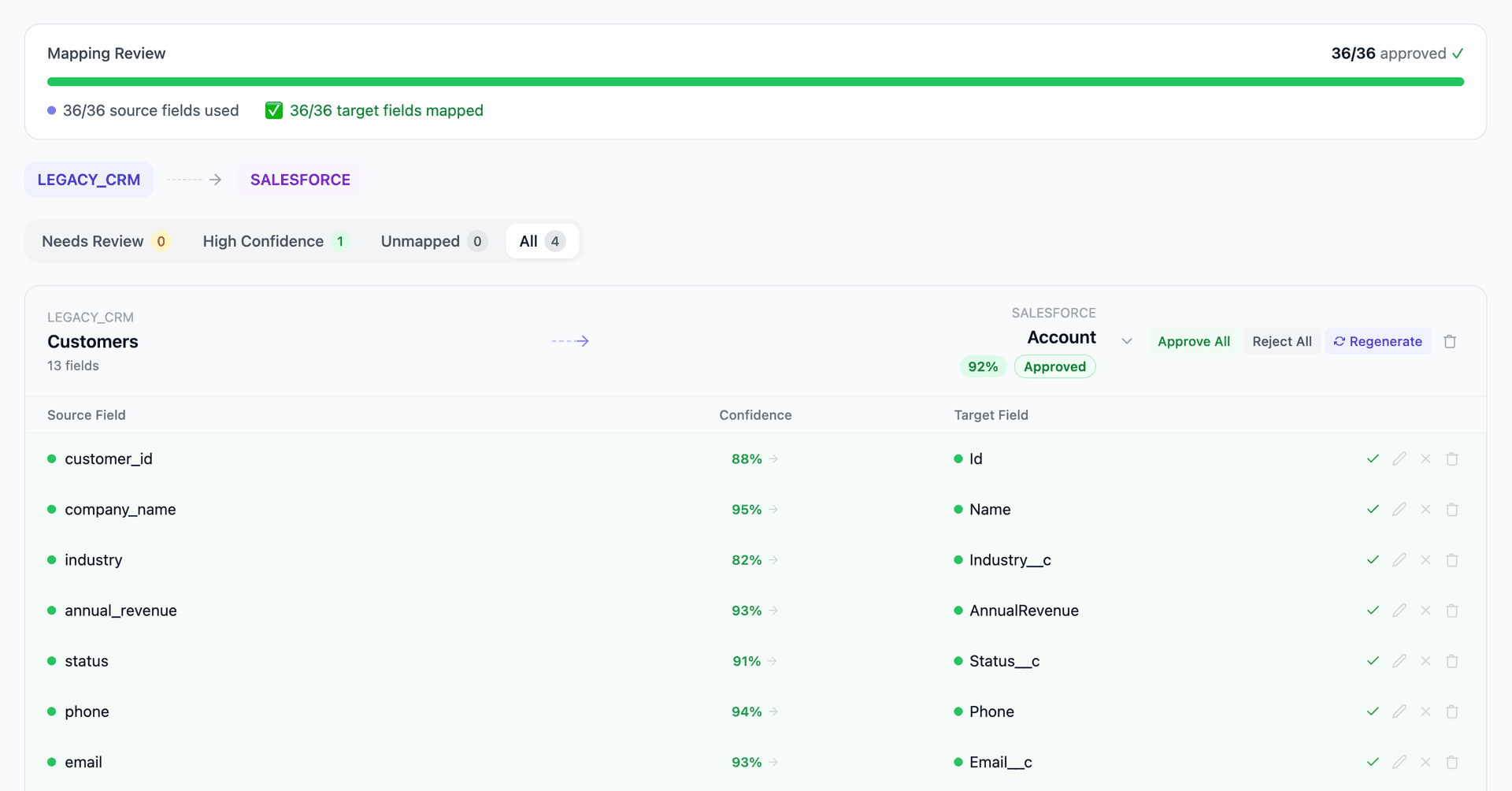
Get your SAP ECC to Microsoft Dynamics 365 mapping analysis — see results in under an hour
Migration timeline: manual vs. Mine
Traditional approach
Timeline
12–24 months
Estimated cost
$2M–10M
Team size
10–20+ consultants
Typically requires
×Manual field mapping in spreadsheets
×Custom ABAP/SQL extraction scripts
×3–5 mock migration cycles
×Dedicated source system consultants
×Manual reconciliation testing
With Mine
Enterprise benchmarksTimeline
8–14 weeks
Team size
3–5 internal resources
Estimated cost
40–50% less
Included
✓Schema profiling & analysis
✓AI-generated field mappings
✓Transformation SQL
✓Validation & readiness reports
✓Production-ready load files
Common challenges migrating from SAP ECC to Microsoft Dynamics 365
SAP organizational hierarchy to D365 legal entity/site model
SAP ECC's organizational structure — company codes, sales organizations, distribution channels, divisions, plants, storage locations — is more granular than D365's legal entity/site/warehouse model. Mapping decisions cascade across all transactional data. A single SAP plant may map to a D365 site, warehouse, or operating unit depending on how it's used.
Explore related migrations →SAP table structures to D365 data entities
SAP ECC uses hundreds of normalized tables accessible via direct SQL or RFC. D365 F&O uses data entities as the primary import interface — each entity aggregates multiple tables with business logic layers. Not all SAP fields surface in standard D365 data entities, and custom entities may need to be created for SAP-specific data patterns.
Explore related migrations →SAP controlling (CO) to D365 financial dimensions
SAP's controlling module — cost centers, profit centers, internal orders, WBS elements — is deeply integrated with the GL. D365 uses financial dimensions as the primary classification mechanism, with project accounting handled separately. Translating SAP CO structures to D365 dimensions requires rethinking how management reporting works.
Explore related migrations →Material master complexity
SAP's material master spans MARA, MARC, MVKE, MBEW, and MARD tables with plant-level, sales org-level, and valuation-level attributes. D365's Released Product entity consolidates much of this but uses product dimensions (configuration, size, color, style) differently. Flattening SAP's multi-view material model while preserving the right detail level is a major mapping challenge.
Explore related migrations →IDOC and custom ABAP interface dependencies
SAP integrations often use IDOCs, BAPIs, and custom ABAP function modules that reference specific table structures. These data dependencies must be identified and mapped to D365 equivalents — typically data entities, OData endpoints, or Power Platform connectors.
Explore related migrations →SAP ECC to Microsoft Dynamics 365 field mapping — what data moves
11 data objects typically migrated
| Source Object | → | Target Object |
|---|---|---|
| KNA1/KNB1/KNVV (Customer Master) | → | CustCustomerV3Entity |
| LFA1/LFB1 (Vendor Master) | → | VendVendorV2Entity |
| SKA1/SKB1 (GL Accounts) | → | MainAccount / Chart of Accounts |
| MARA/MARC/MVKE (Materials) | → | ReleasedProductV2Entity |
| VBAK/VBAP (Sales Orders) | → | SalesOrderHeaderV2Entity |
| EKKO/EKPO (Purchase Orders) | → | PurchaseOrderHeaderV2Entity |
| BKPF/BSEG (Accounting Docs) | → | LedgerJournalEntity |
| CSKS (Cost Centers) | → | Financial Dimensions |
| PRPS (WBS Elements) | → | Project Entity |
| MBEW (Material Valuation) | → | Product costing entity |
| Z-Tables (Custom) | → | Custom Data Entities |
Typical enterprise migrations include 500K–10M+ records across these objects. Mine handles profiling and mapping at any scale.
The cost of manual SAP ECC to Microsoft Dynamics 365 migration
This migration is typically managed by large system integrators (Deloitte, Accenture, Infosys) over 12–24 months. The data conversion workstream alone — profiling custom tables, mapping organizational structures, translating master and transactional data — consumes 30–40% of the total program effort.
Frequently asked questions
Related migration paths
In one enterprise migration, a single field mapping error in customer master data caused $100K in billing discrepancies that went undetected for 6 months.
Mine catches these issues before they reach production.
Built by a team that led SAP, Oracle, and Salesforce data migration programs for Fortune 500 companies at a Big 4 consulting firm. Currently in design partnership with enterprise clients running active migration programs.
Ready to migrate from SAP ECC to Microsoft Dynamics 365?
Tell us about your migration and we'll show you how Mine can help.
No commitment required. We'll review your migration scope and share a preliminary assessment within 48 hours.
You'll receive a preliminary mapping analysis showing how your source objects map to your target schema, with confidence scores and flagged risk areas.