
PeopleSoft to Oracle Cloud Data Migration
Following Oracle's upgrade path? Mine automates the mapping between PeopleSoft's effective-dated model and Oracle Cloud's HDL/FBDI import architecture — handling the structural translation that makes this intra-vendor migration surprisingly complex.
Working with enterprise teams on active migration programs
6–10 weeks
to production-ready mappings
40–50%
cost reduction vs. manual migration
90%+
average mapping confidence
Most enterprise migrations start 6+ months behind schedule. Yours doesn't have to.
This guide is for VPs of IT, data architects, and migration leads at companies moving data from PeopleSoft to Oracle Cloud — whether you're scoping, planning, or mid-program.
Despite both being Oracle products, PeopleSoft and Oracle Cloud use fundamentally different architectures. PeopleSoft uses effective-dated rows in PeopleTools-based tables, while Oracle Cloud requires data loaded through HCM Data Loader (HDL) for HR or FBDI templates for financials. Mine generates correctly formatted HDL/FBDI files from PeopleSoft data with the required loading sequences.
Based on enterprise migration programs led by Mine's founding team
Last updated March 2026
How Mine automates your PeopleSoft to Oracle Cloud migration
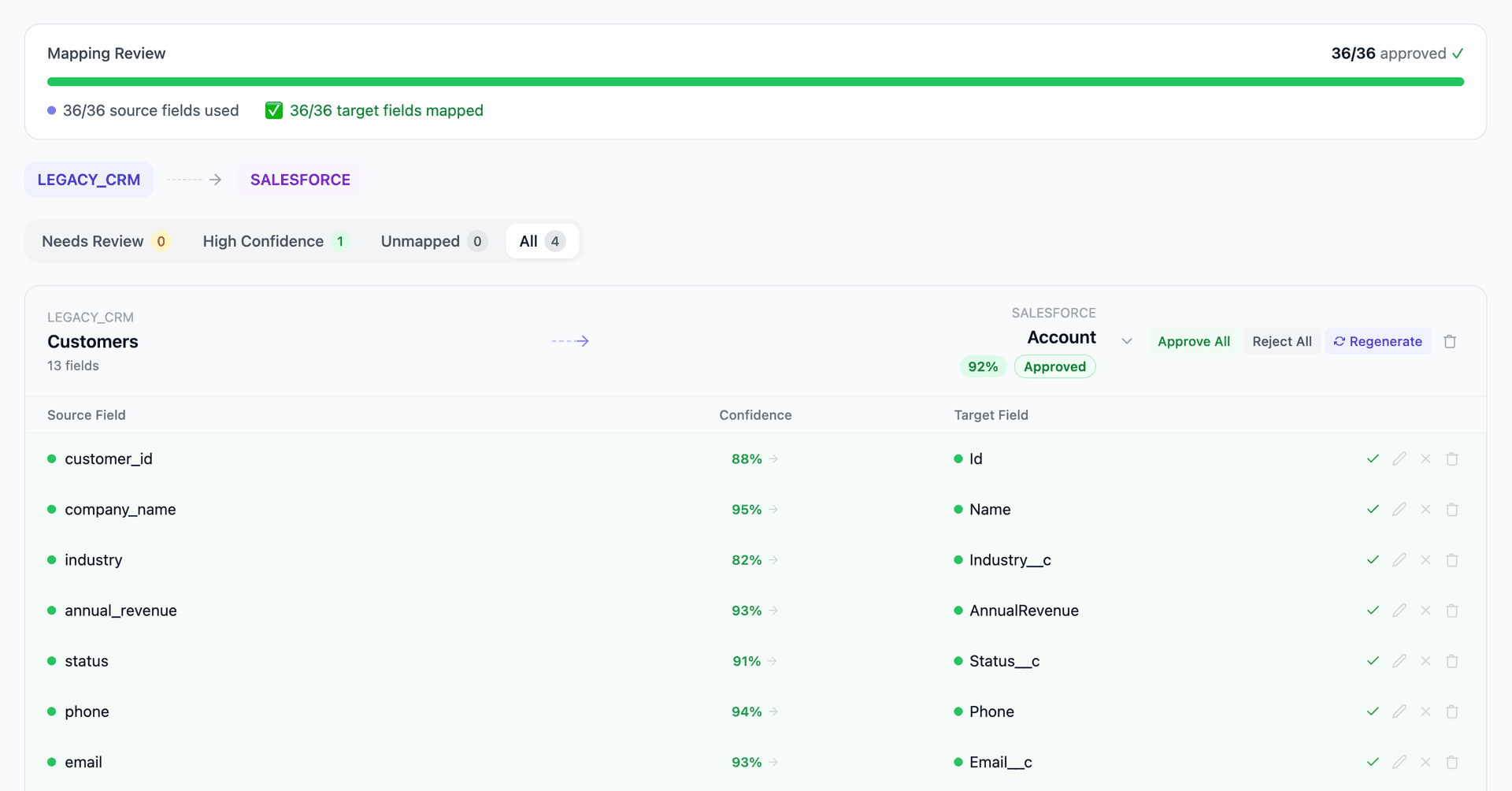
Mine generates correctly formatted HDL and FBDI files from PeopleSoft data — handling the format specifications, mandatory field defaults, and effective-date translation for each loader type.
PeopleSoft customizations are profiled against Oracle Cloud's extension framework — Mine categorizes each custom object as Cloud-compatible (Application Composer), needs redesign, or must be retired.
Setup data dependency chains are analyzed and loading sequences generated — ensuring departments, jobs, locations, and grades load before worker data imports.
Mine validates the conversion against Oracle Cloud's business rules — catching data issues that would cause HDL/FBDI rejection before you attempt the load.
Get your PeopleSoft to Oracle Cloud mapping analysis — see results in under an hour
Migration timeline: manual vs. Mine
Traditional approach
Timeline
12–18 months
Estimated cost
$2M–8M
Team size
8–15 consultants
Typically requires
×Manual field mapping in spreadsheets
×Custom ABAP/SQL extraction scripts
×3–5 mock migration cycles
×Dedicated source system consultants
×Manual reconciliation testing
With Mine
Enterprise benchmarksTimeline
6–10 weeks
Team size
2–4 internal resources
Estimated cost
40–50% less
Included
✓Schema profiling & analysis
✓AI-generated field mappings
✓Transformation SQL
✓Validation & readiness reports
✓Production-ready load files
Common challenges migrating from PeopleSoft to Oracle Cloud
Effective-dated rows to HDL/FBDI format
PeopleSoft's effective-dated rows must be transformed into Oracle Cloud's loader format. HDL uses a specific dat file format with headers and effective-dated records structured differently than PeopleSoft's row model. FBDI uses CSV templates with exact column ordering. Mine generates both formats from PeopleSoft source data.
Explore related migrations →PeopleSoft customizations vs. Oracle Cloud extensibility
PeopleSoft allows deep customization through PeopleCode, record modifications, and component interface changes. Oracle Cloud is a SaaS platform with limited customization — extensions through Application Composer, sandboxes, and OTBI reports. Many PeopleSoft customizations have no direct Cloud equivalent.
Explore related migrations →Higher education and industry-specific modules
PeopleSoft Campus Solutions (student records, financial aid, admissions) has specific data models that map to Oracle Student Cloud with different structures. PeopleSoft's government and higher education vertical features require individual analysis for Cloud equivalence.
Explore related migrations →Setup data dependency chains
Oracle Cloud requires setup data (business units, departments, job codes, locations, grades) to be loaded and validated before worker data can import. PeopleSoft's setup data structure differs from Cloud's configuration model. The loading sequence is strict and failures cascade.
Explore related migrations →PeopleSoft to Oracle Cloud field mapping — what data moves
10 data objects typically migrated
| Source Object | → | Target Object |
|---|---|---|
| PS_JOB (Job Data) | → | Worker HDL |
| PS_PERSONAL_DATA | → | Person HDL |
| PS_COMPENSATION | → | Compensation HDL |
| PS_BENEF_PLAN_ENROLLMT | → | Benefits HDL |
| PS_DEPT_TBL | → | Department Setup |
| PS_POSITION_DATA | → | Position Setup |
| PS_LEDGER (GL) | → | Journal Import FBDI |
| PS_VENDOR (AP) | → | Supplier FBDI |
| PS_CUSTOMER (AR) | → | Customer FBDI |
| PS_ABSENCE_HIST | → | Absence HDL |
Typical enterprise migrations include 500K–10M+ records across these objects. Mine handles profiling and mapping at any scale.
The cost of manual PeopleSoft to Oracle Cloud migration
Oracle provides the PeopleSoft-to-Cloud Migration Toolkit, but it covers standard data objects only. Organizations with extensive customization — which is most PeopleSoft installations — face significant manual effort for custom fields, modified components, and bolt-on modules.
Frequently asked questions
Related migration paths
In one enterprise migration, a single field mapping error in customer master data caused $100K in billing discrepancies that went undetected for 6 months.
Mine catches these issues before they reach production.
Built by a team that led SAP, Oracle, and Salesforce data migration programs for Fortune 500 companies at a Big 4 consulting firm. Currently in design partnership with enterprise clients running active migration programs.
Ready to migrate from PeopleSoft to Oracle Cloud?
Tell us about your migration and we'll show you how Mine can help.
No commitment required. We'll review your migration scope and share a preliminary assessment within 48 hours.
You'll receive a preliminary mapping analysis showing how your source objects map to your target schema, with confidence scores and flagged risk areas.