
QuickBooks Enterprise to NetSuite Data Migration
Outgrowing QuickBooks? Migrate your financial data, customer records, and transaction history to NetSuite with AI-powered automation. Mine handles the schema translation between QuickBooks' flat structure and NetSuite's multi-subsidiary model.
Working with enterprise teams on active migration programs
2–3 weeks
to production-ready mappings
40–50%
cost reduction vs. manual migration
90%+
average mapping confidence
Most enterprise migrations start 6+ months behind schedule. Yours doesn't have to.
This guide is for VPs of IT, data architects, and migration leads at companies moving data from QuickBooks Enterprise to NetSuite — whether you're scoping, planning, or mid-program.
QuickBooks Enterprise uses a flat, single-segment chart of accounts with simple customer and vendor records, while NetSuite uses a multi-dimensional accounting structure with subsidiaries, departments, classes, and locations. Mine decomposes QuickBooks' embedded account segments into NetSuite's dimensional model using pattern recognition on your actual chart of accounts.
Based on enterprise migration programs led by Mine's founding team
Last updated March 2026
How Mine automates your QuickBooks Enterprise to NetSuite migration
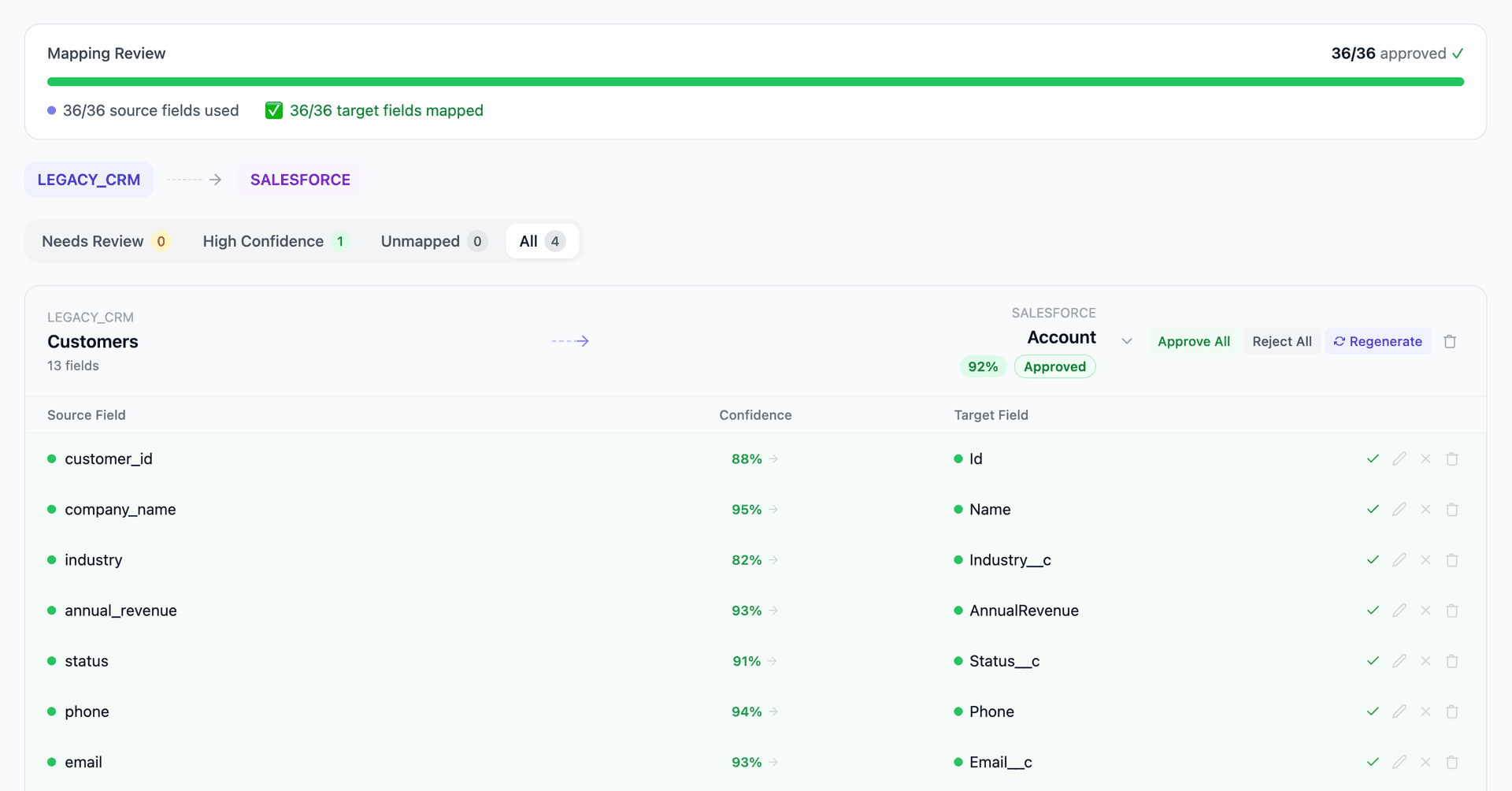
Mine analyzes your QuickBooks chart of accounts and automatically proposes the dimensional decomposition — splitting embedded segments into NetSuite accounts, departments, classes, and locations based on naming pattern recognition.
Multiple QuickBooks data extraction formats (IIF, QODBC, CSV) are supported. Mine profiles whichever format you provide and flags data loss compared to the full QuickBooks schema.
Transaction type mapping rules are generated automatically — QuickBooks Invoices to NetSuite Invoices, Sales Receipts to Cash Sales, etc. — with status, date, and posting rule translation included.
Mine validates opening balances after migration — ensuring the trial balance in NetSuite matches QuickBooks as of cutover date, with sub-ledger reconciliation for AR and AP.
Get your QuickBooks Enterprise to NetSuite mapping analysis — see results in under an hour
Migration timeline: manual vs. Mine
Traditional approach
Timeline
2–4 months
Estimated cost
$50K–200K
Team size
1–3 consultants
Typically requires
×Manual field mapping in spreadsheets
×Custom ABAP/SQL extraction scripts
×3–5 mock migration cycles
×Dedicated source system consultants
×Manual reconciliation testing
With Mine
Enterprise benchmarksTimeline
2–3 weeks
Team size
1 internal resource
Estimated cost
40–50% less
Included
✓Schema profiling & analysis
✓AI-generated field mappings
✓Transformation SQL
✓Validation & readiness reports
✓Production-ready load files
Common challenges migrating from QuickBooks Enterprise to NetSuite
Flat chart of accounts to multi-dimensional NetSuite
QuickBooks uses a flat, single-segment chart of accounts (e.g., '6100 - Office Supplies - Marketing'). NetSuite uses a multi-dimensional structure where the account (6100 Office Supplies), department (Marketing), class, and location are separate fields. Decomposing QuickBooks' embedded segments into NetSuite dimensions requires pattern analysis across the entire account list.
Explore related migrations →QuickBooks data extraction limitations
QuickBooks Enterprise doesn't expose a clean relational database. Data access options include IIF export (lossy, text-based), QODBC driver (slow, with query limitations), or direct QBW file access (requires SDK). Each method has different data fidelity — some lose custom field data, others can't export certain transaction types. Mine must handle whichever extraction format you can provide.
Explore related migrations →Transaction type mapping
QuickBooks uses generic transaction types (Invoice, Sales Receipt, Credit Memo, Check, Bill, Bill Payment) with limited customization. NetSuite uses a richer transaction model with custom transaction types, approval workflows, and subsidiary-specific numbering. Each QuickBooks transaction type must be mapped to the correct NetSuite equivalent with proper form, status, and posting rules.
Explore related migrations →Class and location tracking differences
QuickBooks' class tracking is optional and limited — a single class per transaction or line item. NetSuite supports mandatory department, class, and location fields at both header and line level with different inheritance rules. Historical QuickBooks data may have inconsistent or missing class assignments that need to be enriched during migration.
Explore related migrations →QuickBooks Enterprise to NetSuite field mapping — what data moves
11 data objects typically migrated
| Source Object | → | Target Object |
|---|---|---|
| Customer | → | Customer |
| Vendor | → | Vendor |
| Chart of Accounts | → | Account + Dimensions |
| Item (Inventory/Service/Non-Inventory) | → | Item |
| Invoice | → | Invoice |
| Sales Receipt | → | Cash Sale |
| Bill | → | Vendor Bill |
| Check / Bill Payment | → | Vendor Payment |
| Purchase Order | → | Purchase Order |
| Estimate | → | Estimate / Opportunity |
| Journal Entry | → | Journal Entry |
Typical enterprise migrations include 500K–10M+ records across these objects. Mine handles profiling and mapping at any scale.
The cost of manual QuickBooks Enterprise to NetSuite migration
Companies typically use NetSuite's native CSV import or partner tools like Celigo, but these require all the mapping and transformation work to be done manually upfront. For companies with 3–5 years of QuickBooks history, this manual approach takes 2–4 months of dedicated effort.
Frequently asked questions
Related migration paths
In one enterprise migration, a single field mapping error in customer master data caused $100K in billing discrepancies that went undetected for 6 months.
Mine catches these issues before they reach production.
Built by a team that led SAP, Oracle, and Salesforce data migration programs for Fortune 500 companies at a Big 4 consulting firm. Currently in design partnership with enterprise clients running active migration programs.
Ready to migrate from QuickBooks Enterprise to NetSuite?
Tell us about your migration and we'll show you how Mine can help.
No commitment required. We'll review your migration scope and share a preliminary assessment within 48 hours.
You'll receive a preliminary mapping analysis showing how your source objects map to your target schema, with confidence scores and flagged risk areas.