
Sage Intacct to NetSuite Data Migration
Move from Sage Intacct to NetSuite with AI-powered data migration. Mine handles the dimensional accounting restructuring, custom object mapping, and multi-entity consolidation that make this migration deceptively complex.
Working with enterprise teams on active migration programs
3–5 weeks
to production-ready mappings
40–50%
cost reduction vs. manual migration
90%+
average mapping confidence
Most enterprise migrations start 6+ months behind schedule. Yours doesn't have to.
This guide is for VPs of IT, data architects, and migration leads at companies moving data from Sage Intacct to NetSuite — whether you're scoping, planning, or mid-program.
Sage Intacct uses up to 10 user-defined dimensions that can be flexibly applied at transaction header and line level, while NetSuite uses a fixed classification structure of subsidiaries, departments, classes, and locations. Mine analyzes how each Intacct dimension is actually used in your data and maps it to the optimal NetSuite classification field — preserving reporting continuity.
Based on enterprise migration programs led by Mine's founding team
Last updated March 2026
How Mine automates your Sage Intacct to NetSuite migration
Mine profiles all Intacct user-defined dimensions and proposes the optimal NetSuite mapping — whether department, class, location, or custom segment — based on actual usage patterns in your transaction data.
Multi-entity hierarchies are mapped to NetSuite's subsidiary structure with intercompany elimination rules translated and validated against NetSuite's consolidation engine.
Intacct custom objects and platform services data are profiled and mapped to NetSuite custom records with relationship fields and workflow triggers documented for SuiteScript rebuild.
Mine validates dimensional reporting continuity — ensuring that any Intacct dimension-based report can be replicated in NetSuite using the mapped classification structure.
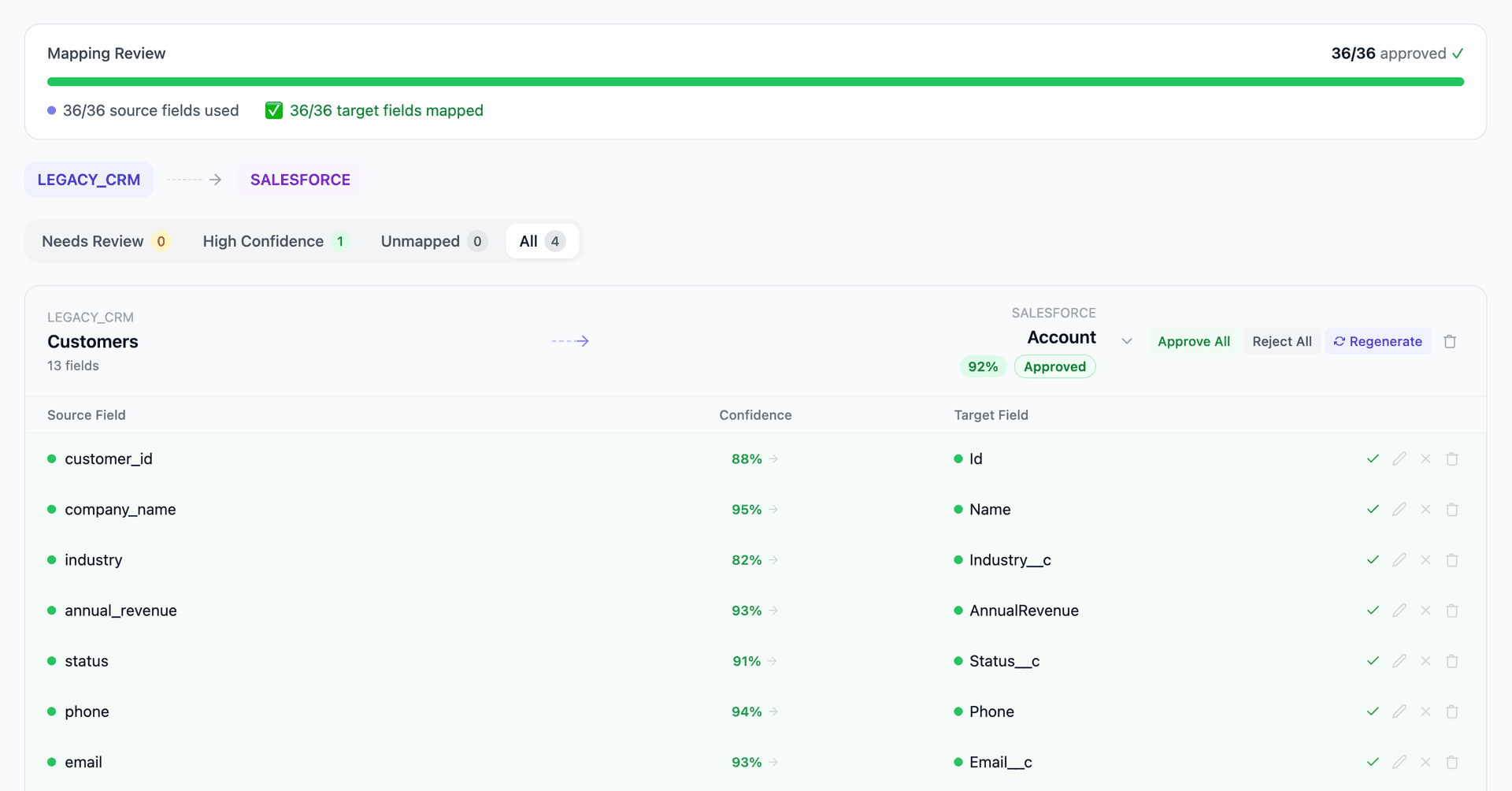
Get your Sage Intacct to NetSuite mapping analysis — see results in under an hour
Migration timeline: manual vs. Mine
Traditional approach
Timeline
3–6 months
Estimated cost
$150K–500K
Team size
2–4 consultants
Typically requires
×Manual field mapping in spreadsheets
×Custom ABAP/SQL extraction scripts
×3–5 mock migration cycles
×Dedicated source system consultants
×Manual reconciliation testing
With Mine
Enterprise benchmarksTimeline
3–5 weeks
Team size
1–2 internal resources
Estimated cost
40–50% less
Included
✓Schema profiling & analysis
✓AI-generated field mappings
✓Transformation SQL
✓Validation & readiness reports
✓Production-ready load files
Common challenges migrating from Sage Intacct to NetSuite
User-defined dimension mapping to NetSuite classifications
Sage Intacct supports up to 10 user-defined dimensions that can be freely applied to transactions. NetSuite uses a fixed structure — subsidiary, department, class, location — plus custom segments for additional dimensions. Not all Intacct dimensions map cleanly to NetSuite's classification fields. Some may need to become custom segments, custom fields, or even separate custom records in NetSuite.
Explore related migrations →Multi-entity consolidation differences
Intacct's multi-entity structure supports top-level and child entities with intercompany elimination rules. NetSuite's OneWorld uses a different subsidiary hierarchy and elimination subsidiary model. The consolidation structure, intercompany journal rules, and currency translation methods all need to be redesigned.
Explore related migrations →Contract billing and revenue recognition
Intacct's contract and revenue management module stores contract schedules, revenue recognition plans, and billing schedules in a purpose-built data model. NetSuite's Advanced Revenue Management uses different recognition methods and scheduling logic. Migrating active contracts with in-progress revenue schedules requires careful period-by-period reconciliation.
Explore related migrations →Intacct custom objects and platform services
Intacct's Platform Services allow custom objects, custom transactions, and smart events. These have no direct NetSuite equivalent — each custom object must be analyzed and rebuilt as a NetSuite custom record with SuiteScript triggers replacing Intacct smart events.
Explore related migrations →Sage Intacct to NetSuite field mapping — what data moves
12 data objects typically migrated
| Source Object | → | Target Object |
|---|---|---|
| Customer | → | Customer |
| Vendor | → | Vendor |
| GL Account | → | Account |
| GL Journal Entry | → | Journal Entry |
| AP Bill | → | Vendor Bill |
| AR Invoice | → | Invoice |
| Purchase Order | → | Purchase Order |
| Order Entry Transaction | → | Sales Order |
| Item | → | Item |
| Employee | → | Employee |
| Contract / Revenue Schedule | → | Revenue Arrangement |
| Custom Objects (Platform Services) | → | Custom Record |
Typical enterprise migrations include 500K–10M+ records across these objects. Mine handles profiling and mapping at any scale.
The cost of manual Sage Intacct to NetSuite migration
Companies typically use CSV exports from Intacct combined with NetSuite's CSV import, but the dimensional restructuring and custom object translation require extensive manual transformation in spreadsheets before the data can load.
Frequently asked questions
Related migration paths
In one enterprise migration, a single field mapping error in customer master data caused $100K in billing discrepancies that went undetected for 6 months.
Mine catches these issues before they reach production.
Built by a team that led SAP, Oracle, and Salesforce data migration programs for Fortune 500 companies at a Big 4 consulting firm. Currently in design partnership with enterprise clients running active migration programs.
Ready to migrate from Sage Intacct to NetSuite?
Tell us about your migration and we'll show you how Mine can help.
No commitment required. We'll review your migration scope and share a preliminary assessment within 48 hours.
You'll receive a preliminary mapping analysis showing how your source objects map to your target schema, with confidence scores and flagged risk areas.