
Siebel CRM to Salesforce Data Migration
Retire Siebel and move to Salesforce with AI-powered data migration. Mine automates the complex mapping between Siebel's on-premise relational model and Salesforce's cloud-native architecture.
Working with enterprise teams on active migration programs
6–10 weeks
to production-ready mappings
40–50%
cost reduction vs. manual migration
90%+
average mapping confidence
Most enterprise migrations start 6+ months behind schedule. Yours doesn't have to.
This guide is for VPs of IT, data architects, and migration leads at companies moving data from Siebel CRM to Salesforce — whether you're scoping, planning, or mid-program.
Siebel CRM uses a highly normalized on-premise relational model with extension columns (ATTRIB_01 through ATTRIB_50), multi-value groups for many-to-many relationships, and decades of accumulated customizations, while Salesforce uses a cloud-native object model with explicit custom fields and junction objects. Mine reads Siebel's repository metadata to decode extension columns into meaningful Salesforce field mappings.
Based on enterprise migration programs led by Mine's founding team
Last updated March 2026
How Mine automates your Siebel CRM to Salesforce migration
Mine reads Siebel's repository metadata to decode extension columns — mapping ATTRIB_01 through X_CUSTOM_50 to meaningful Salesforce custom fields based on the business component configuration, not just the generic column names.
Multi-value groups and intersection tables are automatically profiled and mapped to Salesforce junction objects or native relationships (AccountContactRelation) — preserving roles, primary flags, and relationship dates.
Mine auto-maps Siebel Service Requests to Salesforce Cases with status translation, priority mapping, and activity history preservation — including escalation paths and resolution codes.
Siebel's picklist (LOV) values are extracted from the repository and aligned with Salesforce picklist values — flagging mismatches and generating value mapping tables for each field.
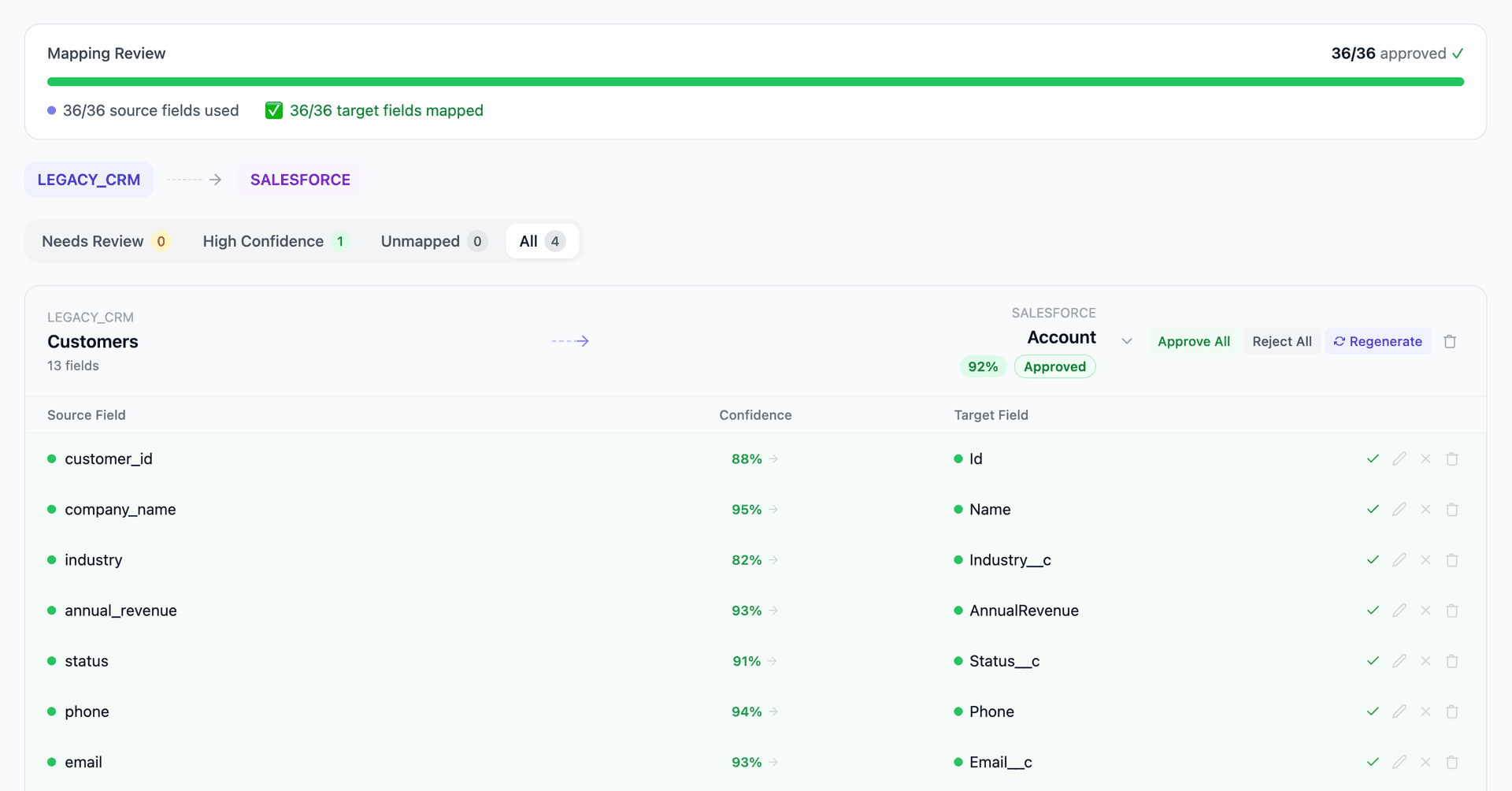
Get your Siebel CRM to Salesforce mapping analysis — see results in under an hour
Migration timeline: manual vs. Mine
Traditional approach
Timeline
12–18 months
Estimated cost
$1.5M–5M
Team size
8–15 consultants
Typically requires
×Manual field mapping in spreadsheets
×Custom ABAP/SQL extraction scripts
×3–5 mock migration cycles
×Dedicated source system consultants
×Manual reconciliation testing
With Mine
Enterprise benchmarksTimeline
6–10 weeks
Team size
2–3 internal resources
Estimated cost
40–50% less
Included
✓Schema profiling & analysis
✓AI-generated field mappings
✓Transformation SQL
✓Validation & readiness reports
✓Production-ready load files
Common challenges migrating from Siebel CRM to Salesforce
Siebel extension columns to Salesforce custom fields
Siebel uses generic extension columns (ATTRIB_01 through ATTRIB_50, X_CUSTOM_01 through X_CUSTOM_50) on base tables, with the column's meaning defined in configuration, not the schema. Salesforce uses explicitly named custom fields (Custom_Field__c). Mapping requires reading Siebel's repository metadata to understand what each extension column actually stores, then creating the corresponding Salesforce custom field.
Explore related migrations →Multi-value groups and intersection tables
Siebel uses multi-value groups (MVGs) to model many-to-many relationships — for example, a contact associated with multiple accounts. These are stored in intersection tables (S_PARTY_PER, S_CONTACT_BU). Salesforce uses junction objects or AccountContactRelation. The MVG-to-junction-object translation must preserve relationship attributes (roles, dates, primary flags).
Explore related migrations →Siebel Organization-based access control
Siebel segments data visibility by Organization (S_ORG_EXT), Position, and Responsibility. Salesforce uses Profiles, Roles, Sharing Rules, and OWD settings. The access control model translation isn't just a data migration issue — it affects which records should be visible to which users post-migration and requires parallel security design.
Explore related migrations →Service request and activity model differences
Siebel's Service Request (S_SRV_REQ) model with activities (S_EVT_ACT), action items, and resolution codes is deeply integrated with Siebel's assignment engine. Salesforce Cases use a different workflow with Case Teams, Entitlements, and Milestones. The activity and resolution history must be mapped to preserve service-level reporting continuity.
Explore related migrations →Siebel CRM to Salesforce field mapping — what data moves
11 data objects typically migrated
| Source Object | → | Target Object |
|---|---|---|
| S_ORG_EXT (Account) | → | Account |
| S_CONTACT (Contact) | → | Contact |
| S_OPTY (Opportunity) | → | Opportunity |
| S_OPTY_PROD (Opportunity Product) | → | OpportunityLineItem |
| S_SRV_REQ (Service Request) | → | Case |
| S_EVT_ACT (Activity) | → | Task / Event |
| S_PROD_INT (Product) | → | Product2 |
| S_ADDR_PER (Address) | → | Account/Contact Address |
| S_PARTY_PER (Party/Relationship) | → | AccountContactRelation / Junction |
| S_NOTE (Notes) | → | ContentNote |
| S_ASSET (Asset) | → | Asset |
Typical enterprise migrations include 500K–10M+ records across these objects. Mine handles profiling and mapping at any scale.
The cost of manual Siebel CRM to Salesforce migration
Traditional Siebel-to-Salesforce migrations are run by large consulting firms over 12–18 months using middleware tools like Informatica or Dell Boomi. The data mapping alone — across accounts, contacts, opportunities, service requests, activities, and custom objects — typically takes 3–4 months of manual analysis.
Frequently asked questions
In one enterprise migration, a single field mapping error in customer master data caused $100K in billing discrepancies that went undetected for 6 months.
Mine catches these issues before they reach production.
Built by a team that led SAP, Oracle, and Salesforce data migration programs for Fortune 500 companies at a Big 4 consulting firm. Currently in design partnership with enterprise clients running active migration programs.
Ready to migrate from Siebel CRM to Salesforce?
Tell us about your migration and we'll show you how Mine can help.
No commitment required. We'll review your migration scope and share a preliminary assessment within 48 hours.
You'll receive a preliminary mapping analysis showing how your source objects map to your target schema, with confidence scores and flagged risk areas.