
BambooHR to Workday Data Migration
Outgrowing BambooHR? Mine automates the mapping between BambooHR's flat employee model and Workday's worker-centric architecture — preserving employee records, job history, compensation, benefits enrollment, and time-off balances.
Working with enterprise teams on active migration programs
3–6 weeks
to production-ready mappings
40–50%
cost reduction vs. manual migration
90%+
average mapping confidence
Most enterprise migrations start 6+ months behind schedule. Yours doesn't have to.
This guide is for VPs of IT, data architects, and migration leads at companies moving data from BambooHR to Workday — whether you're scoping, planning, or mid-program.
BambooHR stores employee data in a flat record model with custom fields, job history tabs, and benefit enrollment tables accessible through its API and CSV exports. Workday uses a fundamentally different worker-centric model with effective-dated business processes, supervisory organizations, and compensation plans. Mine translates BambooHR's simple HRIS data to Workday's event-driven architecture automatically.
Based on enterprise migration programs led by Mine's founding team
Last updated March 2026
How Mine automates your BambooHR to Workday migration
Mine reconstructs BambooHR's job history entries as Workday staffing events — mapping each title change, department transfer, and compensation adjustment to the correct Workday business process event type with proper effective dates.
BambooHR's flat department/manager structure is transformed into Workday's supervisory organization hierarchy — Mine infers the org tree from reporting relationships and generates the complete supervisory org structure.
Benefits enrollment data is translated from BambooHR's simple plan/coverage model to Workday's structured benefit election framework with plan mapping, coverage type alignment, and dependent enrollment preservation.
Time-off balances are calculated as of cutover date for every employee and time-off type — generating Workday opening balances that ensure no employee loses accrued PTO during the transition.
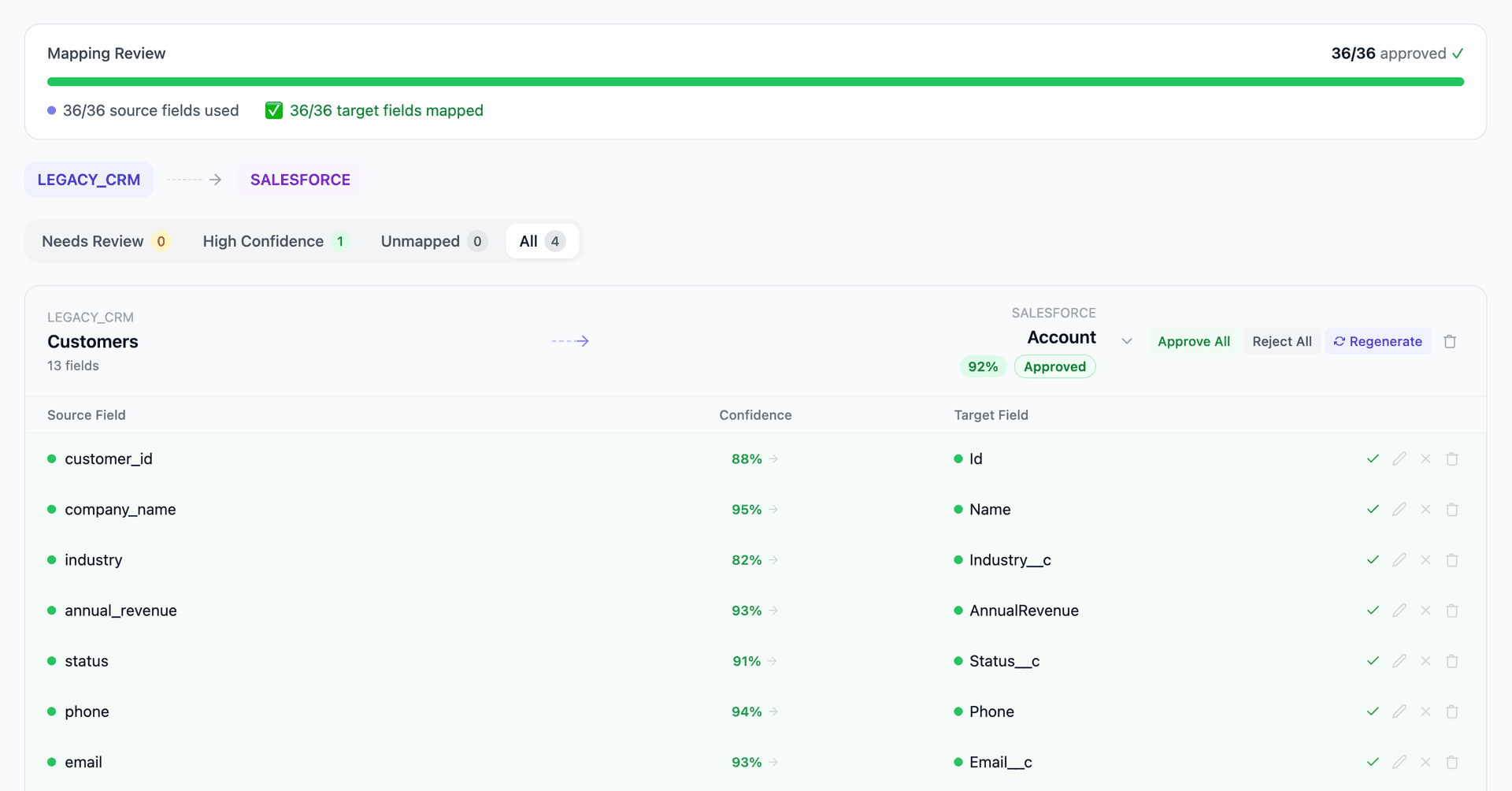
Get your BambooHR to Workday mapping analysis — see results in under an hour
Migration timeline: manual vs. Mine
Traditional approach
Timeline
6–12 months
Estimated cost
$300K–1.2M
Team size
3–8 consultants
Typically requires
×Manual field mapping in spreadsheets
×Custom ABAP/SQL extraction scripts
×3–5 mock migration cycles
×Dedicated source system consultants
×Manual reconciliation testing
With Mine
Enterprise benchmarksTimeline
3–6 weeks
Team size
1–3 internal resources
Estimated cost
40–50% less
Included
✓Schema profiling & analysis
✓AI-generated field mappings
✓Transformation SQL
✓Validation & readiness reports
✓Production-ready load files
Common challenges migrating from BambooHR to Workday
Flat employee records to event-driven worker model
BambooHR stores employee data as flat records with job information, compensation, and personal details on a single profile. Workday requires each change to be represented as an effective-dated business process event — hire, job change, compensation change, transfer, termination. Mine reconstructs BambooHR's job history entries as Workday staffing events with proper effective dates and event types.
Explore related migrations →Org structure to supervisory organizations
BambooHR uses departments and locations with manager reporting lines. Workday uses supervisory organizations — a hierarchical structure where each org has a manager, members, and subordinate orgs. The translation from BambooHR's flat department list to Workday's supervisory org tree requires building the management hierarchy. Mine infers the org tree from BambooHR's manager fields and generates the Workday supervisory org structure.
Explore related migrations →Benefits enrollment translation
BambooHR tracks benefits enrollment with plan names, coverage levels, and dependent information. Workday uses a structured benefits model with benefit plans, benefit groups, coverage types, and benefit elections tied to life events. The structural translation from BambooHR's simple enrollment records to Workday's event-driven benefits framework requires careful mapping of plan types and coverage levels.
Explore related migrations →Time-off balance carryover
BambooHR tracks PTO, sick leave, and custom time-off types with accrual balances. Workday uses absence plans with different accrual calculation methods, carryover rules, and balance tracking. Leave balances must be calculated as of the cutover date and loaded into Workday as opening balances. Mine calculates the point-in-time balance for each employee and time-off type.
Explore related migrations →Custom fields and data completeness
BambooHR allows custom fields on employee records — custom tabs, custom dropdowns, and custom text fields. These need Workday custom field equivalents. Additionally, BambooHR's simpler data requirements mean fields that Workday considers mandatory (worker type, job family, pay rate type) may not exist in BambooHR and need default values or enrichment.
Explore related migrations →BambooHR to Workday field mapping — what data moves
12 data objects typically migrated
| Source Object | → | Target Object |
|---|---|---|
| Employee Record | → | Worker |
| Job History | → | Staffing Event (Hire, Job Change, Transfer) |
| Compensation | → | Compensation Plan / Compensation Change |
| Department | → | Supervisory Organization |
| Location | → | Location |
| Job Title / Position | → | Job Profile / Position |
| Benefits Enrollment | → | Benefit Election |
| Dependents | → | Dependent |
| Emergency Contact | → | Emergency Contact |
| Time Off Balance | → | Time Off Balance (opening) |
| Employee Address / Phone / Email | → | Worker Address / Contact Info |
| Custom Fields | → | Custom Fields / Custom Objects |
Typical enterprise migrations include 500K–10M+ records across these objects. Mine handles profiling and mapping at any scale.
The cost of manual BambooHR to Workday migration
Companies typically engage Workday implementation partners for 6–12 months. The data conversion — mapping BambooHR's flat records to Workday's event model, reconstructing job history as staffing events, and migrating benefits enrollment — is the most structurally complex part because the data models are so different.
Frequently asked questions
Related migration paths
In one enterprise migration, a single field mapping error in customer master data caused $100K in billing discrepancies that went undetected for 6 months.
Mine catches these issues before they reach production.
Built by a team that led SAP, Oracle, and Salesforce data migration programs for Fortune 500 companies at a Big 4 consulting firm. Currently in design partnership with enterprise clients running active migration programs.
Ready to migrate from BambooHR to Workday?
Tell us about your migration and we'll show you how Mine can help.
No commitment required. We'll review your migration scope and share a preliminary assessment within 48 hours.
You'll receive a preliminary mapping analysis showing how your source objects map to your target schema, with confidence scores and flagged risk areas.