
Shopify to Salesforce Data Migration
Building a customer 360 in Salesforce from your Shopify data? Mine automates the mapping between Shopify's commerce model and Salesforce's CRM objects — customers, products, orders, and purchase history.
Working with enterprise teams on active migration programs
2–4 weeks
to production-ready mappings
40–50%
cost reduction vs. manual migration
90%+
average mapping confidence
Most enterprise migrations start 6+ months behind schedule. Yours doesn't have to.
This guide is for VPs of IT, data architects, and migration leads at companies moving data from Shopify to Salesforce — whether you're scoping, planning, or mid-program.
Shopify stores commerce data in a product-variant-order model optimized for ecommerce, while Salesforce organizes data around Accounts, Contacts, Opportunities, and Cases designed for B2B relationships. Mine bridges these fundamentally different models — transforming Shopify's transactional commerce data into Salesforce's relationship-centric CRM structure.
Based on enterprise migration programs led by Mine's founding team
Last updated March 2026
How Mine automates your Shopify to Salesforce migration
Mine transforms Shopify's order-centric data into Salesforce's account-centric model — creating Account and Contact records from Shopify customer data with deduplication and B2B/B2C classification.
Product variants are analyzed and mapped to the optimal Salesforce Product structure — individual Products, custom attributes, or a variant custom object based on your catalog complexity.
Order history is mapped to your chosen Salesforce architecture — Opportunities, custom Order objects, or Salesforce Orders — with line items, discounts, and fulfillment data preserved.
Mine generates customer purchase summaries as Account-level custom fields — total orders, lifetime value, last purchase date, favorite categories — giving your sales team immediate customer intelligence.
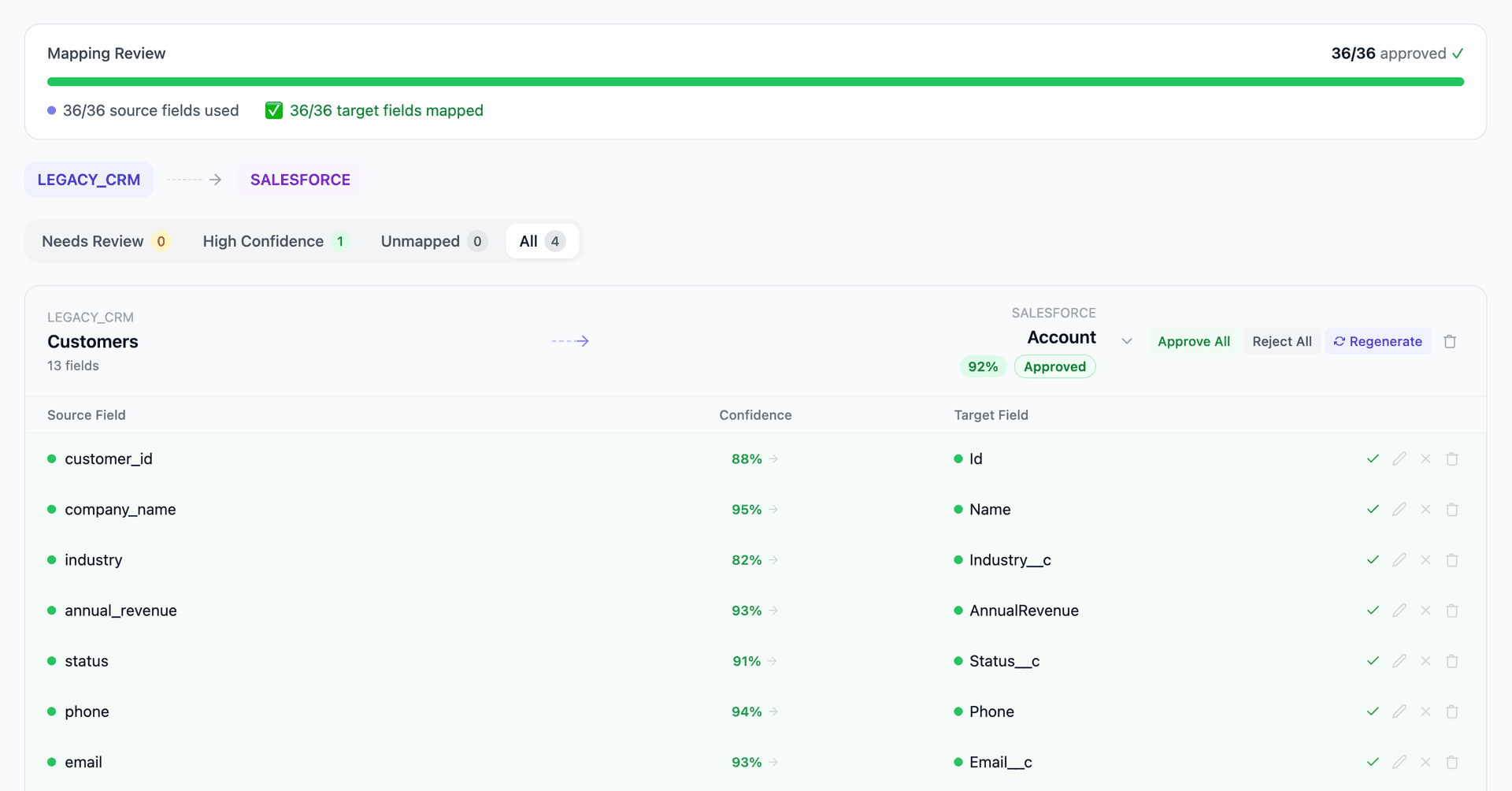
Get your Shopify to Salesforce mapping analysis — see results in under an hour
Migration timeline: manual vs. Mine
Traditional approach
Timeline
2–4 months
Estimated cost
$80K–250K
Team size
2–3 consultants
Typically requires
×Manual field mapping in spreadsheets
×Custom ABAP/SQL extraction scripts
×3–5 mock migration cycles
×Dedicated source system consultants
×Manual reconciliation testing
With Mine
Enterprise benchmarksTimeline
2–4 weeks
Team size
1 internal resource
Estimated cost
40–50% less
Included
✓Schema profiling & analysis
✓AI-generated field mappings
✓Transformation SQL
✓Validation & readiness reports
✓Production-ready load files
Common challenges migrating from Shopify to Salesforce
Transactional model to relational model conversion
Shopify's data is order-centric: everything flows from orders. Salesforce is account-centric: everything flows from the customer relationship. Converting Shopify's flat customer-order structure into Salesforce's Account → Contact → Opportunity → Order architecture requires determining which Shopify data becomes which Salesforce object.
Explore related migrations →Customer identity resolution
Shopify customers may have multiple accounts (guest checkout, registered account, POS). Salesforce needs a clean Account-Contact structure. Resolving Shopify's multiple customer records into unified Salesforce Accounts with Contacts requires email-based deduplication plus business name matching for B2B customers.
Explore related migrations →Order history representation in Salesforce
Salesforce doesn't have a native Order History object that mirrors Shopify's order model. Options include: Salesforce Orders (limited functionality), custom objects, Opportunities (if tracking for pipeline), or external objects. The choice depends on how you plan to use order history in Salesforce — reporting, customer service, or sales intelligence.
Explore related migrations →Product variant structure differences
Shopify variants (size/color/material per product) have no Salesforce equivalent. Salesforce Products are flat with optional price book entries. Variants may become individual Salesforce Products, custom product attributes, or a custom variant object depending on your Salesforce commerce architecture.
Explore related migrations →Shopify to Salesforce field mapping — what data moves
9 data objects typically migrated
| Source Object | → | Target Object |
|---|---|---|
| Customers | → | Account + Contact |
| Products / Variants | → | Product2 |
| Orders | → | Opportunity / Custom Object |
| Order Line Items | → | OpportunityLineItem / Custom |
| Collections | → | Product Family / Custom |
| Customer Tags | → | Account fields / Picklists |
| Fulfillments | → | Custom Object / Activity |
| Refunds | → | Custom Object / Case |
| Discount Usage | → | Custom fields |
Typical enterprise migrations include 500K–10M+ records across these objects. Mine handles profiling and mapping at any scale.
The cost of manual Shopify to Salesforce migration
Companies typically handle this through custom Salesforce development or middleware integration. The initial historical data migration — converting years of Shopify orders into Salesforce's CRM model — is a one-time effort that's often underscoped.
Frequently asked questions
Related migration paths
In one enterprise migration, a single field mapping error in customer master data caused $100K in billing discrepancies that went undetected for 6 months.
Mine catches these issues before they reach production.
Built by a team that led SAP, Oracle, and Salesforce data migration programs for Fortune 500 companies at a Big 4 consulting firm. Currently in design partnership with enterprise clients running active migration programs.
Ready to migrate from Shopify to Salesforce?
Tell us about your migration and we'll show you how Mine can help.
No commitment required. We'll review your migration scope and share a preliminary assessment within 48 hours.
You'll receive a preliminary mapping analysis showing how your source objects map to your target schema, with confidence scores and flagged risk areas.