
Shopify to NetSuite Data Migration
Connecting your Shopify storefront to NetSuite ERP? Mine automates the data mapping between Shopify's commerce model and NetSuite's ERP entity structure — products, customers, orders, inventory, and fulfillment data.
Working with enterprise teams on active migration programs
2–4 weeks
to production-ready mappings
40–50%
cost reduction vs. manual migration
90%+
average mapping confidence
Most enterprise migrations start 6+ months behind schedule. Yours doesn't have to.
This guide is for VPs of IT, data architects, and migration leads at companies moving data from Shopify to NetSuite — whether you're scoping, planning, or mid-program.
Shopify stores product, customer, and order data in a commerce-optimized model with variants, collections, and fulfillments, while NetSuite uses a traditional ERP entity structure with Items, Customers, Sales Orders, and Inventory Details. Mine maps Shopify's ecommerce data model to NetSuite's ERP structure — handling the product variant-to-matrix item translation, customer deduplication, and order type mapping.
Based on enterprise migration programs led by Mine's founding team
Last updated March 2026
How Mine automates your Shopify to NetSuite migration
Mine profiles your Shopify product catalog and recommends the optimal NetSuite item structure — matrix items for products with 1–3 variant axes, individual items for complex variants, with parent-child relationships preserved.
Customer records are deduplicated using email-based matching plus fuzzy matching on name and address — generating a merge map before any data loads into NetSuite.
Shopify orders are automatically routed to the correct NetSuite transaction type — Sales Orders for unfulfilled, Cash Sales for completed, with fulfillments and refunds mapped to their NetSuite transaction counterparts.
Mine validates inventory quantities and order totals after migration — ensuring Shopify and NetSuite balances match before you cut over.
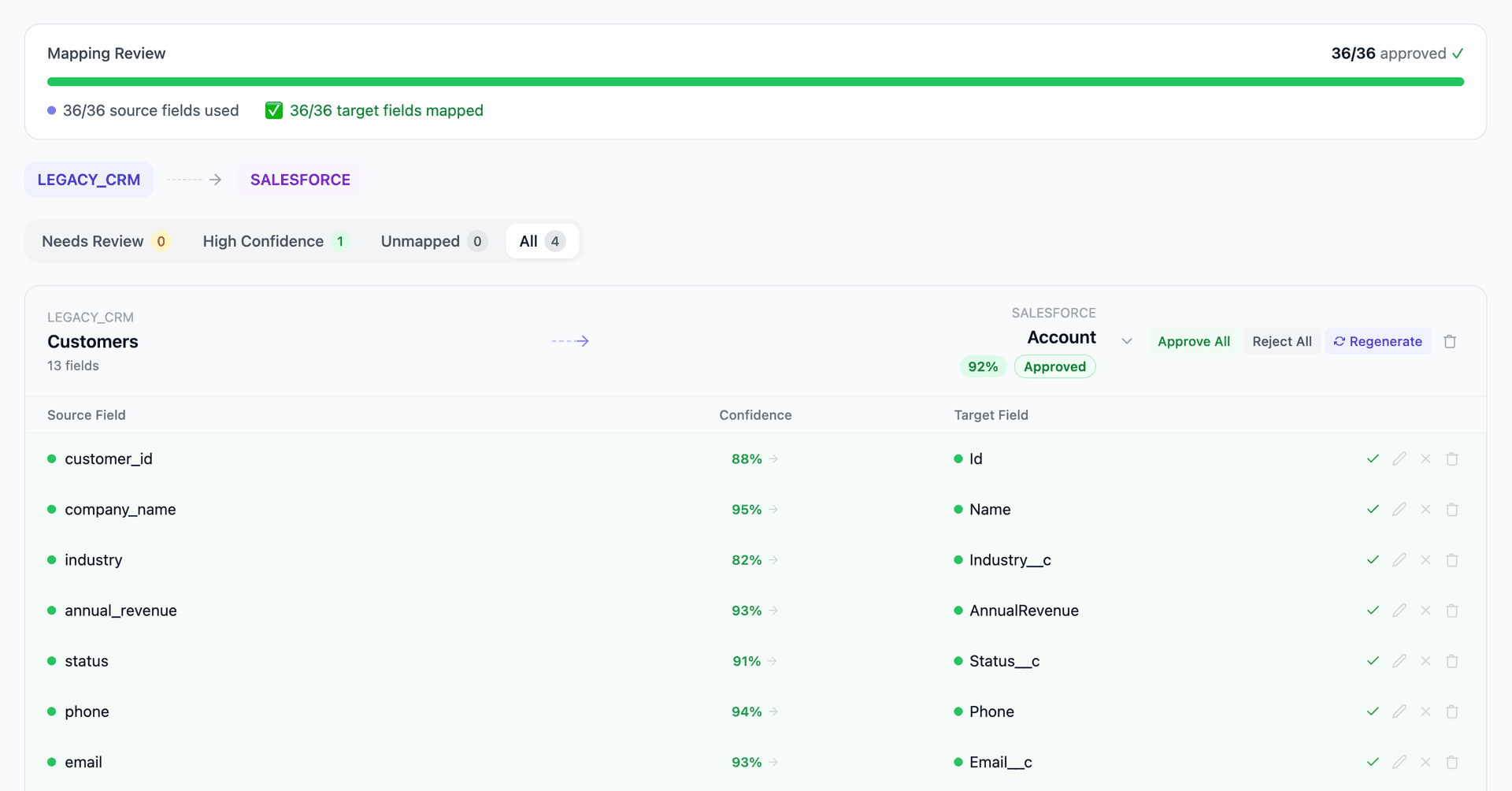
Get your Shopify to NetSuite mapping analysis — see results in under an hour
Migration timeline: manual vs. Mine
Traditional approach
Timeline
2–4 months
Estimated cost
$80K–300K
Team size
2–3 consultants
Typically requires
×Manual field mapping in spreadsheets
×Custom ABAP/SQL extraction scripts
×3–5 mock migration cycles
×Dedicated source system consultants
×Manual reconciliation testing
With Mine
Enterprise benchmarksTimeline
2–4 weeks
Team size
1 internal resource
Estimated cost
40–50% less
Included
✓Schema profiling & analysis
✓AI-generated field mappings
✓Transformation SQL
✓Validation & readiness reports
✓Production-ready load files
Common challenges migrating from Shopify to NetSuite
Product variants to NetSuite item structure
Shopify products with variants (size, color, material) can be modeled in NetSuite as matrix items (parent item with size/color dimensions) or individual items with a parent-child relationship. The choice depends on how you manage inventory and purchasing in NetSuite. Products with more than 3 variant options exceed NetSuite's matrix dimensions and need alternative modeling.
Explore related migrations →Customer deduplication
Shopify creates customer records liberally — guest checkouts, account creations, and order-based customer records can create duplicates. NetSuite requires clean, deduplicated customer records. Email-based matching catches most duplicates, but variations in name, address, and phone across orders require fuzzy matching logic.
Explore related migrations →Order model translation
Shopify's flat order model (order → line items → fulfillments → refunds) must map to NetSuite's transactional chain (Sales Order → Item Fulfillment → Invoice → Cash Sale → Credit Memo). Each Shopify order type (standard, draft, POS) maps to different NetSuite transaction types. Partial fulfillments and partial refunds add complexity.
Explore related migrations →Discount and pricing model differences
Shopify's discount codes, automatic discounts, and gift cards use a different model than NetSuite's promotion codes, price levels, and gift certificate items. Migrating historical order data with accurate discount representation in NetSuite requires translating Shopify's discount allocations to NetSuite's pricing adjustments.
Explore related migrations →Shopify to NetSuite field mapping — what data moves
10 data objects typically migrated
| Source Object | → | Target Object |
|---|---|---|
| Products / Variants | → | Item (Inventory / Matrix) |
| Collections | → | Item Category / Group |
| Customers | → | Customer |
| Orders | → | Sales Order / Cash Sale |
| Order Line Items | → | Item lines on transaction |
| Fulfillments | → | Item Fulfillment |
| Refunds | → | Credit Memo / Customer Refund |
| Inventory Levels | → | Inventory Adjustment |
| Gift Cards | → | Gift Certificate Item |
| Discount Codes | → | Promotion Code |
Typical enterprise migrations include 500K–10M+ records across these objects. Mine handles profiling and mapping at any scale.
The cost of manual Shopify to NetSuite migration
Companies typically set up a real-time integration (Celigo, FarApp) for ongoing sync, but the initial historical data migration — products, customers, and order history — still requires a bulk data conversion effort that's often underestimated.
Frequently asked questions
Related migration paths
In one enterprise migration, a single field mapping error in customer master data caused $100K in billing discrepancies that went undetected for 6 months.
Mine catches these issues before they reach production.
Built by a team that led SAP, Oracle, and Salesforce data migration programs for Fortune 500 companies at a Big 4 consulting firm. Currently in design partnership with enterprise clients running active migration programs.
Ready to migrate from Shopify to NetSuite?
Tell us about your migration and we'll show you how Mine can help.
No commitment required. We'll review your migration scope and share a preliminary assessment within 48 hours.
You'll receive a preliminary mapping analysis showing how your source objects map to your target schema, with confidence scores and flagged risk areas.