
Epicor to Dynamics 365 Data Migration
Moving from Epicor to Dynamics 365? Mine automates the mapping between Epicor's manufacturing data model and D365 Finance & Supply Chain Management — preserving part masters, BOMs, production routes, and financial history.
Working with enterprise teams on active migration programs
5–10 weeks
to production-ready mappings
40–50%
cost reduction vs. manual migration
90%+
average mapping confidence
Most enterprise migrations start 6+ months behind schedule. Yours doesn't have to.
This guide is for VPs of IT, data architects, and migration leads at companies moving data from Epicor to Microsoft Dynamics 365 — whether you're scoping, planning, or mid-program.
Epicor Kinetic stores data in SQL Server tables — Part, Customer, JobHead, JobMtl, JobOper, PartBin — with company/plant segmentation and User Defined fields. Dynamics 365 Finance & Supply Chain Management uses Data Entities and Dataverse tables — Released Products, BOM Versions, Production Routes, and Production Orders. Mine translates Epicor's manufacturing schema to D365's entity model automatically.
Based on enterprise migration programs led by Mine's founding team
Last updated March 2026
How Mine automates your Epicor to Microsoft Dynamics 365 migration
Mine profiles Epicor's Part table and maps each item to D365's Released Products entity — translating part classes and groups to D365 product dimensions, item groups, and model groups.
BOMs and routings are restructured from Epicor's PartMtl/PartOpr model to D365's BOM Versions and Route Versions with proper effective dates, site assignments, and approval status fields.
Mine generates D365 Data Entity import files in the correct format and sequence — handling entity dependencies so customers load before orders, items before BOMs, and dimensions before journal entries.
Chart of accounts restructuring is automated — Mine maps Epicor's segmented accounts to D365 main accounts plus financial dimensions, generating the account mapping and dimension configuration.
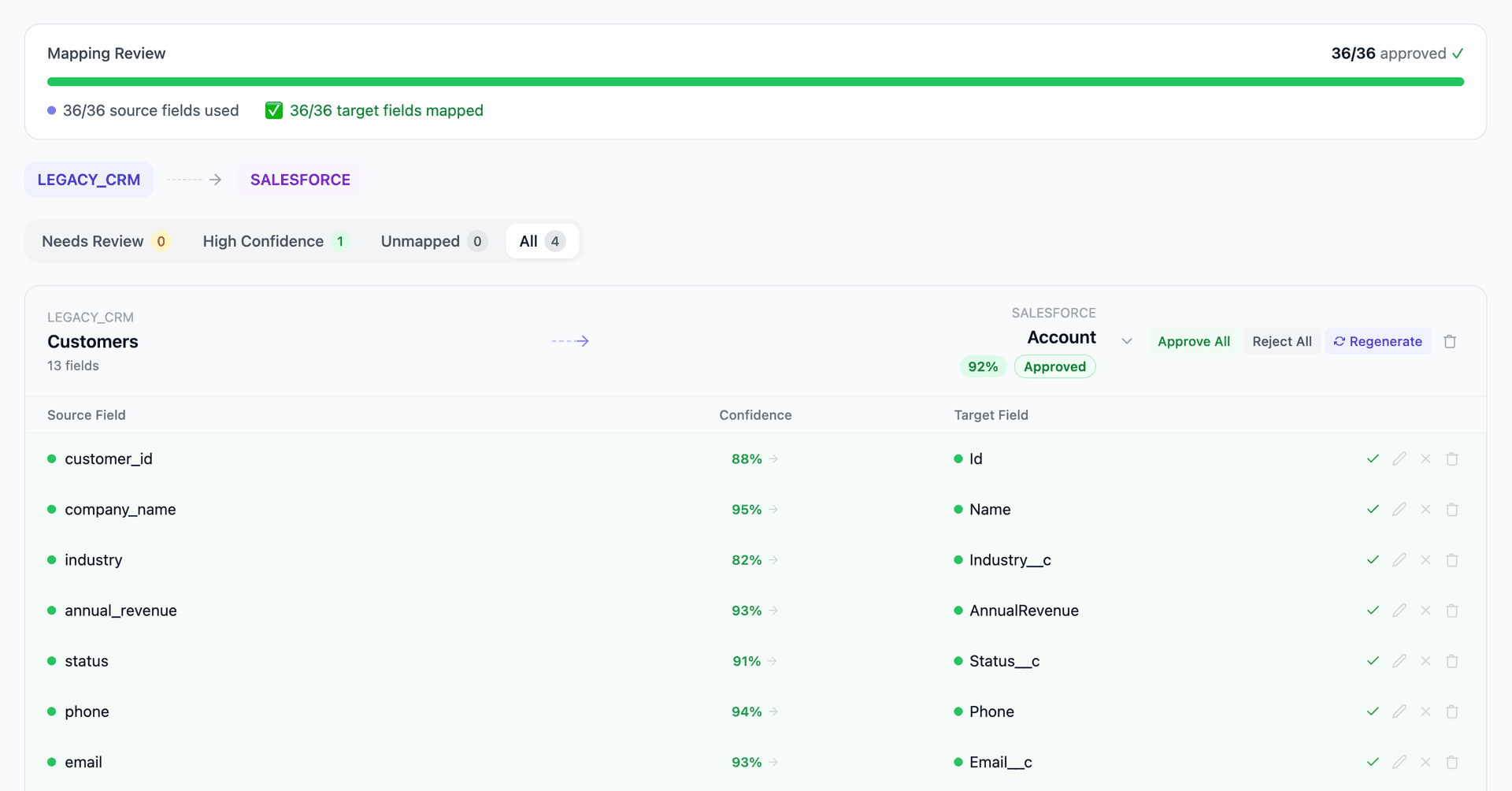
Get your Epicor to Microsoft Dynamics 365 mapping analysis — see results in under an hour
Migration timeline: manual vs. Mine
Traditional approach
Timeline
8–16 months
Estimated cost
$500K–2M
Team size
5–12 D365 consultants
Typically requires
×Manual field mapping in spreadsheets
×Custom ABAP/SQL extraction scripts
×3–5 mock migration cycles
×Dedicated source system consultants
×Manual reconciliation testing
With Mine
Enterprise benchmarksTimeline
5–10 weeks
Team size
2–4 internal resources
Estimated cost
40–50% less
Included
✓Schema profiling & analysis
✓AI-generated field mappings
✓Transformation SQL
✓Validation & readiness reports
✓Production-ready load files
Common challenges migrating from Epicor to Microsoft Dynamics 365
Part master to Released Products translation
Epicor's Part table stores items with part classes, groups, revisions, and plant-level attributes. D365 uses Released Products with product dimensions (configuration, size, color, style), storage dimensions (site, warehouse), and tracking dimensions (batch, serial). The dimensional model is more granular in D365. Mine maps Epicor part attributes to D365 product dimensions and flags items that require dimension group configuration.
Explore related migrations →BOM and routing to D365 BOM Versions and Route Operations
Epicor uses PartMtl (BOM materials) and PartOpr (routing operations) tied to part revisions. D365 uses BOM Versions with BOM Lines and Route Versions with Route Operations — each with effective dates and approval workflows. Mine restructures Epicor's BOM/routing data into D365's versioned model with proper effective dates and site/warehouse assignments.
Explore related migrations →Chart of accounts and financial dimensions
Epicor uses a segmented chart of accounts with natural account, division, and department segments. D365 uses a main account with financial dimensions (department, cost center, business unit) that are configured separately. The chart of accounts restructuring affects every financial transaction in the migration.
Explore related migrations →Data Entity import complexity
D365 imports data through Data Entities in the Data Management Framework — each entity has specific field requirements, sequencing dependencies, and validation rules. Importing customers before addresses, items before BOMs, and financial dimensions before journal entries. Mine generates import files in the correct Data Entity format with proper sequencing.
Explore related migrations →Multi-company and legal entity mapping
Epicor's company/plant hierarchy must map to D365's legal entity/site/warehouse structure. Intercompany transactions, transfer pricing, and shared master data between Epicor companies must be restructured for D365's intercompany framework.
Explore related migrations →Epicor to Microsoft Dynamics 365 field mapping — what data moves
12 data objects typically migrated
| Source Object | → | Target Object |
|---|---|---|
| Part | → | Released Products V2 (Data Entity) |
| Customer | → | Customers V3 (Data Entity) |
| Vendor | → | Vendors V2 (Data Entity) |
| PartMtl / PartOpr | → | BOM Lines / Route Operations |
| JobHead / JobMtl / JobOper | → | Production Orders |
| PartBin | → | On-Hand Inventory (Counting Journal) |
| OrderHed / OrderDtl | → | Sales Order Headers / Lines |
| POHeader / PODetail | → | Purchase Order Headers / Lines |
| GLJrnDtl | → | General Journal (Data Entity) |
| InvcHead / InvcDtl | → | Customer Invoice Journal |
| APInvHed / APInvDtl | → | Vendor Invoice Journal |
| Epicor COA Segments | → | Main Accounts / Financial Dimensions |
Typical enterprise migrations include 500K–10M+ records across these objects. Mine handles profiling and mapping at any scale.
The cost of manual Epicor to Microsoft Dynamics 365 migration
Microsoft partners typically run these migrations over 8–16 months. The data conversion effort — mapping Epicor tables to D365 Data Entities, restructuring BOMs and routes, converting chart of accounts, and migrating financial history — represents 25–35% of the total project.
Frequently asked questions
Related migration paths
In one enterprise migration, a single field mapping error in customer master data caused $100K in billing discrepancies that went undetected for 6 months.
Mine catches these issues before they reach production.
Built by a team that led SAP, Oracle, and Salesforce data migration programs for Fortune 500 companies at a Big 4 consulting firm. Currently in design partnership with enterprise clients running active migration programs.
Ready to migrate from Epicor to Microsoft Dynamics 365?
Tell us about your migration and we'll show you how Mine can help.
No commitment required. We'll review your migration scope and share a preliminary assessment within 48 hours.
You'll receive a preliminary mapping analysis showing how your source objects map to your target schema, with confidence scores and flagged risk areas.